SOLDES
Jusqu'à -70% sur une sélection d'articles*

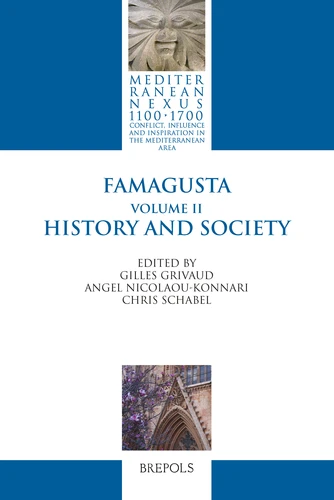
Famagusta. Vol. II: History and Society
Par : , ,Formats :
- Paiement en ligne :
- Livraison à domicile ou en point Mondial Relay estimée à partir du 12 novembreCet article sera commandé chez un fournisseur et vous sera envoyé 127 jours après la date de votre commande.
- Retrait Click and Collect en magasin gratuit
- Livraison à domicile ou en point Mondial Relay estimée à partir du 12 novembre
- Réservation en ligne avec paiement en magasin :
- Indisponible pour réserver et payer en magasin
- Nombre de pages912
- PrésentationRelié
- Poids1.65 kg
- Dimensions15,6 cm × 23,4 cm × 0,0 cm
- ISBN978-2-503-59041-7
- EAN9782503590417
- Date de parution12/02/2021
- CollectionMediterranean Nexus 1100-1700
- ÉditeurBrepols
Résumé
This is the second of two volumes on the history and archaeology of the port city of Famagusta in Cyprus from the beginning of the island's Frankish rule in 1191 to the Ottoman conquest in 1571. The first volume, entitled Art and Architecture and edited by Annemarie Weyl Carr, was published in this series in 2014.The volume provides a comprehensive survey of the four-century history of Famagusta under Frankish, Genoese, and Venetian rule down to the Ottoman siege and conquest, supplemented by an account of the image of the medieval and Renaissance city in retrospect.
Based on original research and often using unpublished sources, fourteen acknowledged specialists study Famagusta's political, social, economic, and ecclesiastical history from a multi- and interdisciplinary approach that involves aspects such as institutional continuities and discontinuities, military and spatial organisation, religious and cultural exchanges, gender roles, and the city's image in travelogues, literature and art.
Such an approach allows a better understanding of the evolution of the ethnically and religiously diverse Famagustian society from a rich commercial centre under the Lusignans to an enclave under the Genoese and a military outpost under the Venetians.
Based on original research and often using unpublished sources, fourteen acknowledged specialists study Famagusta's political, social, economic, and ecclesiastical history from a multi- and interdisciplinary approach that involves aspects such as institutional continuities and discontinuities, military and spatial organisation, religious and cultural exchanges, gender roles, and the city's image in travelogues, literature and art.
Such an approach allows a better understanding of the evolution of the ethnically and religiously diverse Famagustian society from a rich commercial centre under the Lusignans to an enclave under the Genoese and a military outpost under the Venetians.