
Erika Gielen obtained a doctoral degree in Classics from KU Leuven, with a doctoral thesis on the Byzantine philosophers Joseph Racendytes ("De virtute") and Nicephorus Blemmydes ("De virtute et ascesi"). Presently she is Managing Director of the interdisciplinary Research Centre LECTIO (KU Leuven). Jan Papy is Full Professor in Latin and Neo-Latin Literature at the Faculty of Arts of KU Leuven. His research focuses on Renaissance Humanism and Neo-Latin literature, with special attention for Renaissance philosophy, cultural history of the Low Countries, history of universities and history of science.
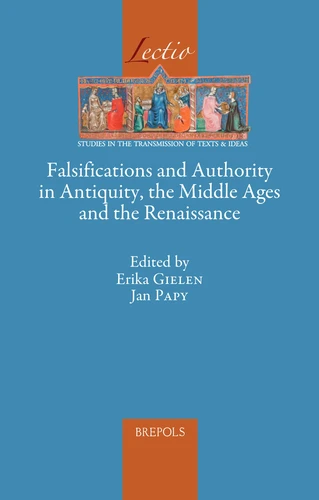
Falsifications and Authority in Antiquity, the Middle Ages and the Renaissance
Par : ,Formats :
- Paiement en ligne :
- Livraison à domicile ou en point Mondial Relay estimée à partir du 22 septembreCet article sera commandé chez un fournisseur et vous sera envoyé 19 jours après la date de votre commande.
- Retrait Click and Collect en magasin gratuit
- Nombre de pages348
- PrésentationRelié
- Poids0.72 kg
- Dimensions15,6 cm × 23,4 cm × 0,0 cm
- ISBN978-2-503-58843-8
- EAN9782503588438
- Date de parution29/09/2020
- CollectionLectio
- ÉditeurBrepols
Résumé
Confronted with the shifting idea of the authority of a text and its transmission and reception in a variety of genres, settings and contexts, this collective volume envisages to enlarge and deepen our understanding of these notions by tangling literary forgery and emulation. Authority and authoritative literary productions provoke all kinds of interest and emulation. Hermeneutical techniques, detailed exegesis and historical critique are invoked to put authority, and indeed also possible falsifications, to the test.
Scholars from various disciplines working on texts, either authoritative or forged, and stemming from different periods of time, reflect on these topics on a methodological basis and from a hermeneutical entrance. In doing so, a threefold axis for questioning the phenomenon is proposed, namely the motif of falsification, the mechanism or technique applied, and the direct or indirect effect of this fraud.
Scholars from various disciplines working on texts, either authoritative or forged, and stemming from different periods of time, reflect on these topics on a methodological basis and from a hermeneutical entrance. In doing so, a threefold axis for questioning the phenomenon is proposed, namely the motif of falsification, the mechanism or technique applied, and the direct or indirect effect of this fraud.