Lodewijk Woltjer studied at Leiden University in Holland. Chairman at the Astronomy Department at Columbia University, he became Director General of ESO from 1915-1981. He has been chairman of the ESA Space Science Advisory Committee and President of the International astronomical Union. For several years now he has been associated with the Observatoire de Haute Provence and also with the Osservatorio Astrofisico di Arcetri in Florence.
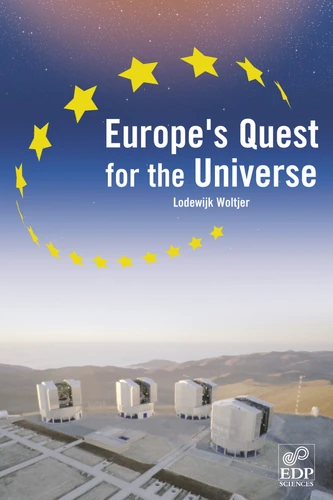
Europe's Quest for the Universe. ESO and the VLT, ESA and other projects
Par :Formats :
- Paiement en ligne :
- Livraison à domicile ou en point Mondial Relay estimée à partir du 16 septembreCet article sera commandé chez un fournisseur et vous sera envoyé 19 jours après la date de votre commande.
- Retrait Click and Collect en magasin gratuit
- Réservation en ligne avec paiement en magasin :
- Indisponible pour réserver et payer en magasin
- Nombre de pages323
- PrésentationBroché
- Poids0.73 kg
- Dimensions16,5 cm × 24,0 cm × 1,9 cm
- ISBN2-86883-813-8
- EAN9782868838131
- Date de parution05/01/2006
- ÉditeurEDP Sciences
Résumé
Some of the more striking results obtained or anticipated on the ground or in space at radio, infrared and visible wavelengths and in X-, gamma-ray and cosmic-rays are covered. The roles of the European Southern Observatory (ESO) and the European Space Agency (ESA) are stressed, but national initiatives are also touched upon. Input into the research system in the form of financing and personnel and output as publications are evaluated.
The time frame covered extends from around 1980 till about 2020. While this book centers on European developments, comparisons with what others are doing are included. After the war Europe in science had fallen far behind the US. Thanks to European cooperation equality has again been reached. Through ESO's Very Large Telescope and ESA's missions, like the Infrared Space Observatory, X- and gamma- ray satellites, Mars Express and others, Europe is fully and independently present at the forefront.
The need to integrate the scientists and engineers from the new EU countries into the overall organization of European science is noted, an integration which ultimately could extend even further eastward. This book addresses a wide audience : astronomers and space scientists, students, politicians involved in science funding, amateur astronomers and the educated public with an interest in the science and technology achievable by European cooperation.
The time frame covered extends from around 1980 till about 2020. While this book centers on European developments, comparisons with what others are doing are included. After the war Europe in science had fallen far behind the US. Thanks to European cooperation equality has again been reached. Through ESO's Very Large Telescope and ESA's missions, like the Infrared Space Observatory, X- and gamma- ray satellites, Mars Express and others, Europe is fully and independently present at the forefront.
The need to integrate the scientists and engineers from the new EU countries into the overall organization of European science is noted, an integration which ultimately could extend even further eastward. This book addresses a wide audience : astronomers and space scientists, students, politicians involved in science funding, amateur astronomers and the educated public with an interest in the science and technology achievable by European cooperation.