

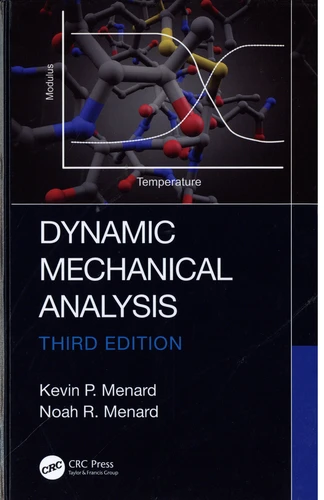
Dynamic Mechanical Analysis
3rd edition
Par : , Formats :
- Nombre de pages260
- FormatGrand Format
- PrésentationRelié
- Poids0.57 kg
- Dimensions18,0 cm × 24,0 cm × 2,2 cm
- ISBN978-1-4822-5551-5
- EAN9781482255515
- Date de parution01/05/2020
- ÉditeurCRC Press
Résumé
Dynamic Mechanical Analysis (DMA) is a powerful technique for understanding the viscoelastic properties of materials. It has become a powerful tool for chemists, polymer and material scientists, and engineers. Despite this, it often remainsunderutilized in the modern laboratory. Because of its high sensitivity to the presence of the glass transition, many users limit it to detecting glass transitions that can't be seen by differential scanning calorimetry (DSC).
This book presents a practical and straightforward approach to understanding how DMA works and what it measures. Starting with the concepts of stress and strain, the text takes the reader through stress-strain, creep, and thermomechanical analysis. DMA is discussed as both the instrument and fixtures as well as the techniques for measuring both thermoplastic and thermosetting behavior. This edition offers expanded chapters on these areas as well as frequency scanning and other application areas.
To help the reader grasp the material, study questions have also been added. Endnotes have been expanded and updated.
This book presents a practical and straightforward approach to understanding how DMA works and what it measures. Starting with the concepts of stress and strain, the text takes the reader through stress-strain, creep, and thermomechanical analysis. DMA is discussed as both the instrument and fixtures as well as the techniques for measuring both thermoplastic and thermosetting behavior. This edition offers expanded chapters on these areas as well as frequency scanning and other application areas.
To help the reader grasp the material, study questions have also been added. Endnotes have been expanded and updated.
L'éditeur en parle
Features : Reflects the latest DMA research and technical advances. Includes case studies to demonstrate the use of DMA over a range of industrial problems. Includes numerous references to help those with limited materials engineering background. Demonstrates the power of DMA as a laboratory tool for analysis and testing.