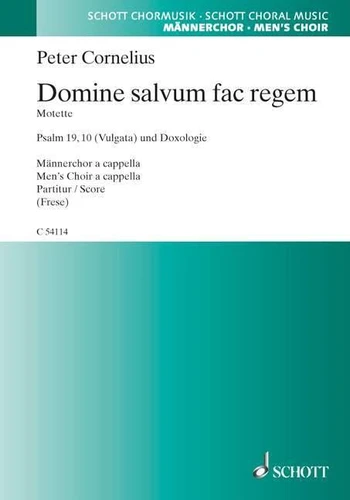
Domine salvum fac regem. Motets for four-part men's choir. men's choir. Partition de chœur.
Par :Formats :
- Paiement en ligne :
- Livraison à domicile ou en point Mondial Relay estimée à partir du 9 octobreCet article sera commandé chez un fournisseur et vous sera envoyé 23 jours après la date de votre commande.
- Retrait Click and Collect en magasin gratuit
- Réservation en ligne avec paiement en magasin :
- Indisponible pour réserver et payer en magasin
- Nombre de pages12
- Poids0.042 kg
- Dimensions19,2 cm × 27,5 cm × 0,0 cm
- ISBN979-0-001-17463-3
- EAN9790001174633
- Date de parution01/01/2011
- CollectionSchott Choral Music
- ÉditeurSchott
- EditeurAndreas Frese
Résumé
When Peter Cornelius (1824-1874), the musically and literarily talented and versatile artist, went to Weimar in 1852 to pursue further studies with Franz Liszt, the latter advised him to 'throw himself into writing sacred music with a will'. He heeded his advice and thereupon wrote a series of liturgical and religious pieces for men's choir as well as the song cycle 'Vater unser'. 'Domine salvum fac regem' too was composed by Cornelius in this context - in two versions : for a cappella men's choir and for solo tenor, mixed choir and orchestra.
The version for men's choir was written in May 1852, setting to music in a 'speaking' and expressive manner the texts compiled from psalm and doxology, with colourful motet-like and block-like sections and a 'Gloria Deo', set as if chiselled, which introduces the final section - an impressive work. Instrumentation : men's choir
The version for men's choir was written in May 1852, setting to music in a 'speaking' and expressive manner the texts compiled from psalm and doxology, with colourful motet-like and block-like sections and a 'Gloria Deo', set as if chiselled, which introduces the final section - an impressive work. Instrumentation : men's choir
L'éditeur en parle
When Peter Cornelius went to Weimar in 1852 to pursue further studies with Franz Liszt, the latter advised him to 'throw himself into writing sacred music with a will'. Thereupon, he wrote a series of religious pieces for men's choir. 'Die Seligkeiten' is set chordally and homophonically throughout and captivates people with its simplicity and expressiveness. 'Domine salvum fac regem' sets to music in a 'speaking' and expressive manner the texts compiled from psalm and doxology, with colourful motet-like and block-like sections and a 'Gloria Deo', set as if chiselled, which introduces the final section - an impressive work.
Besetzung : men's choir
Besetzung : men's choir