In 2003 and again in 2005, the international community was called by the United Nations to take part in a World Summit on the Information Society (WSIS). This two-phased summit placed an unprecedented global spotlight on information and communication issues. At the same time, the WSIS represented a grand experiment in global governance : the active participation of non-governmental stakeholders in the development of public policies at the international level.
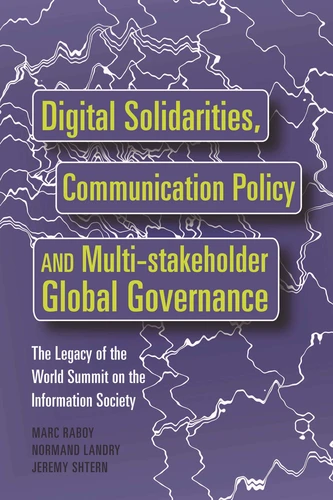
Digital Solidarities, Communication Policy and Multi-stakeholder Global Governance examines the actors, structures and themes that shaped the WSIS with a particular focus on the role played by civil society. The book investigates how civil society self-organization has continued post-WSIS through the Internet Governance Forum (IGF) and other policymaking venues, and reflects on what the WSIS experience reveals about the challenges and opportunities embedded in the notion of multi-stakeholder governance and its implications for understanding global communication.
In 2003 and again in 2005, the international community was called by the United Nations to take part in a World Summit on the Information Society (WSIS). This two-phased summit placed an unprecedented global spotlight on information and communication issues. At the same time, the WSIS represented a grand experiment in global governance : the active participation of non-governmental stakeholders in the development of public policies at the international level.
Digital Solidarities, Communication Policy and Multi-stakeholder Global Governance examines the actors, structures and themes that shaped the WSIS with a particular focus on the role played by civil society. The book investigates how civil society self-organization has continued post-WSIS through the Internet Governance Forum (IGF) and other policymaking venues, and reflects on what the WSIS experience reveals about the challenges and opportunities embedded in the notion of multi-stakeholder governance and its implications for understanding global communication.