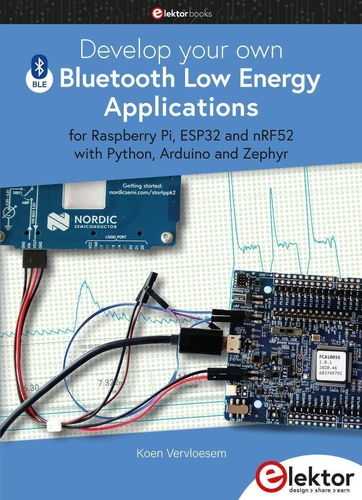
Develop your own Bluetooth Low Energy Applications. For Raspberry Pi, ESP32 and nRF52 with Python, Arduino and Zephyr
Par :Formats :
- Paiement en ligne :
- Livraison à domicile ou en point Mondial Relay estimée à partir du 8 octobreCet article sera commandé chez un fournisseur et vous sera envoyé 25 jours après la date de votre commande.
- Retrait Click and Collect en magasin gratuit
- Réservation en ligne avec paiement en magasin :
- Indisponible pour réserver et payer en magasin
- Nombre de pages258
- FormatGrand Format
- PrésentationBroché
- Poids0.496 kg
- Dimensions16,8 cm × 24,0 cm × 1,7 cm
- ISBN978-3-89576-500-1
- EAN9783895765001
- Date de parution06/07/2023
- ÉditeurElektor
Résumé
Bluetooth Low Energy (BLE) radio chips are ubiquitous from Raspberry Pi to light bulbs. BLE is an elaborate technology with a comprehensive specification, but the basics are quite accessible. A progressive and systematic approach will lead you far in mastering this wireless communication technique, which is essential for working in low power scenarios. In this book, you'll learn how to : -Discover BLE devices in the neighborhood by listening to their advertisements.
-Create your own BLE devices advertising data. -Connect to BLE devices such as heart rate monitors and proximity reporters. -Create secure connections to BLE devices with encryption and authentication. -Understand BLE service and profile specifications and implement them. -Reverse engineer a BLE device with a proprietary implementation and control it with your own software. -Make your BLE devices use as little power as possible.
This book shows you the ropes of BLE programming with Python and the Bleak library on a Raspberry Pi or PC, with C++ and NimBLE-Arduino on Espressif's ESP32 development boards, and with C on one of the development boards supported by the Zephyr real-time operating system, such as Nordic Semiconductor's nRF52 boards. Starting with a very little amount of theory, you'll develop code right from the beginning.
After you've completed this book, you'll know enough to create your own BLE applications.
-Create your own BLE devices advertising data. -Connect to BLE devices such as heart rate monitors and proximity reporters. -Create secure connections to BLE devices with encryption and authentication. -Understand BLE service and profile specifications and implement them. -Reverse engineer a BLE device with a proprietary implementation and control it with your own software. -Make your BLE devices use as little power as possible.
This book shows you the ropes of BLE programming with Python and the Bleak library on a Raspberry Pi or PC, with C++ and NimBLE-Arduino on Espressif's ESP32 development boards, and with C on one of the development boards supported by the Zephyr real-time operating system, such as Nordic Semiconductor's nRF52 boards. Starting with a very little amount of theory, you'll develop code right from the beginning.
After you've completed this book, you'll know enough to create your own BLE applications.