

Harry L. Van Trees, ScD, was Professor of Electrical Engineering at Massachusetts Institute of Technology. He served as Chief Scientist of the U.S. Air Force, Chief Scientist of the Defense Communications Agency, and Principle Deputy Assistant Secretary of Defense for C3I. He was President of M/A-Com-Linkabit Government Systems and a cofounder of CommOuest Technologies. He is currently Distinguished Professor of Electrical Engineering and Director of the C3l Center of Excellence at George Mason University, Fairfax, Virginia.
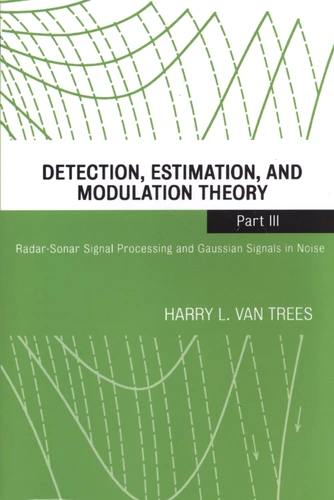
Detection, Estimation, and Modulation Theory. Part III, Radar-Sonar Signal Processing and Gaussian Signals in Noise
Par :Formats :
- Nombre de pages626
- FormatGrand Format
- PrésentationBroché
- Poids0.9 kg
- Dimensions15,0 cm × 23,0 cm × 2,6 cm
- ISBN0-471-10793-X
- EAN9780471107934
- Date de parution01/01/2001
- ÉditeurWiley
Résumé
Originally published in 1968, Harry Van Trees's Detection, Estimation, and Modulation Theory, Part III is one of the great time-tested classics in the field of signal processing. Highly readable and practically organized, it is as imperative today for professionals, researchers, and students in optimum signal processing as it was over thirty years ago. Part III focuses on radar-sonar signal processing and Gaussian signals in noise.
The following topics are covered in detail : Detection of Gaussian signals in white Gaussian noise ; General binary detection : Gaussian processes ; Estimation of the parameters of a random process ; The radar-sonar problem ; Parameter estimation : slowly fluctuating point targets ; Doppler-spread targets and channels ; Range-spread targets and channels ; Doubly-spread targets and channels. The results are still largely applicable to current systems.
For students in signal processing or professionals looking for a reliable refresher course, Detection, Estimation, and Modulation Theory, Part III provides authoritative, practical coverage by one of the most renowned figures in the field. Part III also provides necessary background for Optimum Array Processing, Part IV of Detection, Estimation, and Modulation Theory.
The following topics are covered in detail : Detection of Gaussian signals in white Gaussian noise ; General binary detection : Gaussian processes ; Estimation of the parameters of a random process ; The radar-sonar problem ; Parameter estimation : slowly fluctuating point targets ; Doppler-spread targets and channels ; Range-spread targets and channels ; Doubly-spread targets and channels. The results are still largely applicable to current systems.
For students in signal processing or professionals looking for a reliable refresher course, Detection, Estimation, and Modulation Theory, Part III provides authoritative, practical coverage by one of the most renowned figures in the field. Part III also provides necessary background for Optimum Array Processing, Part IV of Detection, Estimation, and Modulation Theory.