
The Editor : Harlan Koff is Assistant Professor of Political Science and the Director of the Political Science Institute at the University of Luxembourg. He also co-coordinates the University's European Governance Research Program. His research focuses on comparative immigration politics, comparative border politics, comparative regional integration, and international human rights.
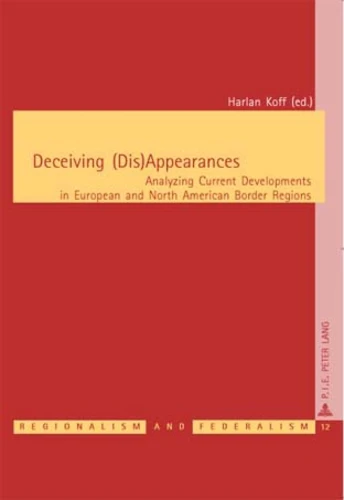
Deceiving (Dis)Appearances. Analyzing Current Developments in European and North American Border Regions
Par :Formats :
- Nombre de pages232
- PrésentationBroché
- Dimensions22,0 cm × 15,0 cm × 0,0 cm
- ISBN978-90-5201-369-5
- EAN9789052013695
- Date de parution08/02/2014
- CollectionPLG.HUMANITIES
- ÉditeurPeter Lang AG
Résumé
The impact of recent shifts in global geopolitics and economic markets has led to the re-conceptualization of national borders. Scholars have shifted their analysis away from the narrow idea of "borders", and moved their attention towards the wider view of "borderlands", "border regions", and "border zones", thus, leading to the conceptual re-definition of border politics. These recent approaches have identified border areas as socially constructed territories that demonstrate many of the characteristics of independent polities.
Border communities seem to have come to life, creating a degree of autonomy and separation from central state actors. While the rich literature in border studies identifies important changes in local political and economic systems, it does not necessarily identify the mechanisms that create these changes : Why has integration occurred in some border regions while others are being reinforced ? Why has integration failed in some cases where opportunity structures are positive, while it has succeeded in others saddled with more limited constraints ? The essays in this volume address such fundamental questions.
Border communities seem to have come to life, creating a degree of autonomy and separation from central state actors. While the rich literature in border studies identifies important changes in local political and economic systems, it does not necessarily identify the mechanisms that create these changes : Why has integration occurred in some border regions while others are being reinforced ? Why has integration failed in some cases where opportunity structures are positive, while it has succeeded in others saddled with more limited constraints ? The essays in this volume address such fundamental questions.