

Bryan Ward-Perkins is a Professor of History at the University of Oxford and Principal Investigator of the ERC-funded Cult of Saints in Late Antiquity project, which is examining and making available on-line the evidence for saintly cult from its origins in the 4th century up to around AD 7..Antonio Felle is a Professor of Archaeology and Epigraphy at the Università degli Studi ‘Aldo Moro' di Bari, an expert on the Christian epigraphy of Rome, and Director of the on-line Epigraphic Database Bari, which collects and makes available the epigraphic evidence for early Christianity.
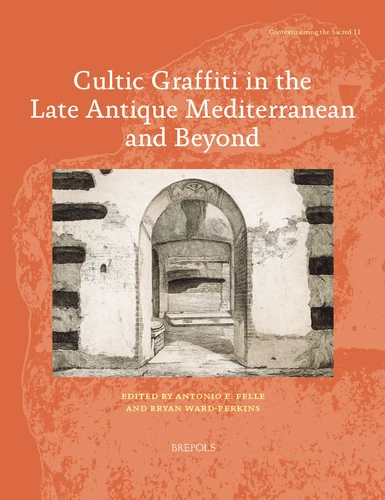
Cultic Graffiti in the Late Antique Mediterranean and Beyond
Par : ,Formats :
- Paiement en ligne :
- Livraison à domicile ou en point Mondial Relay estimée à partir du 8 octobreCet article sera commandé chez un fournisseur et vous sera envoyé 23 jours après la date de votre commande.
- Retrait Click and Collect en magasin gratuit
- Nombre de pages192
- FormatGrand Format
- PrésentationBroché
- Poids0.86 kg
- Dimensions21,6 cm × 28,0 cm × 1,5 cm
- ISBN978-2-503-59311-1
- EAN9782503593111
- Date de parution27/08/2021
- CollectionContextualizing the Sacred
- ÉditeurBrepols
Résumé
Studies of cultic practice in Late Antiquity generally rely on texts written by the ecclesiastical elite, providing a lens - and often, a hagiographical agenda - through which the actions of devotees must be viewed. A singular exception to this is graffiti, scratched or drawn on the walls of religious shrines, with the personal messages of individual worshippers. This volume presents and discusses cultic graffiti across the late antique Mediterranean, and beyond into Nubia and Arabia, exploring this unmediated evidence of ordinary men and women invoking and seeking the help of God and the saints.
While the principal focus of many of the chapters gathered here is the Christian world, attention is also paid to pre-Christian practice as well as to the world of early Islam. Taking an interdisciplinary approach that draws on the evidence of both history and archaeology, these contributions offer important insights into how men and women interacted with the divine during Late Antiquity.
While the principal focus of many of the chapters gathered here is the Christian world, attention is also paid to pre-Christian practice as well as to the world of early Islam. Taking an interdisciplinary approach that draws on the evidence of both history and archaeology, these contributions offer important insights into how men and women interacted with the divine during Late Antiquity.
L'éditeur en parle
Sacred space, its use, development and meaning, is a major theme in archaeology and ancient history, and productive of research questions relating to religious identity, performance and practice, change, innovation, and dissolution. This series seeks to integrate the study of archaeology, texts, architecture, and religion, creating a forum for interdisciplinary and comparative studies of landscapes and domains of evidence that are normally treated separately.
The series is open to thematic, cross-regional and diachronic studies, as well as specific works within ancient history, classical archaeology, Egyptology, Assyriology, archaeology and philology that treat sacred space and its material culture in regions encompassed by the designation 'Ancient Near East'. Studies that seek to make issues and questions from one area accessible and thought-provoking to scholars in another are welcome.
The series is open to thematic, cross-regional and diachronic studies, as well as specific works within ancient history, classical archaeology, Egyptology, Assyriology, archaeology and philology that treat sacred space and its material culture in regions encompassed by the designation 'Ancient Near East'. Studies that seek to make issues and questions from one area accessible and thought-provoking to scholars in another are welcome.