

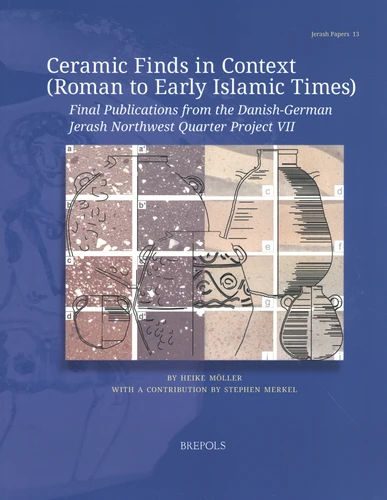
Ceramic Finds in Context (Roman to Early Islamic Times). Final Publications from the Danish-German Jerash Northwest Quarter Project VII
Par :Formats :
- Nombre de pages262
- FormatGrand Format
- PrésentationBroché
- Poids0.755 kg
- Dimensions21,5 cm × 28,0 cm × 1,7 cm
- ISBN978-2-503-60997-3
- EAN9782503609973
- Date de parution01/01/2024
- CollectionJerash Papers
- ÉditeurBrepols
- ContributeurStephen Merkel
Résumé
The Decapolis city of Jerash has long attracted attention from travellers and scholars, due both to the longevity of the site and the remarkable finds uncovered during successive phases of excavation that have taken place from 1902 onwards. Between 2011 and 2016, a Danish-German team, led by the universities of Aarhus and Münster, focused their attention on the Northwest Quarter of Jerash - the highest point within the walled city - and this volume is the seventh in a series of books presenting the team's final results.
This volume provides an in-depth analysis into the ceramic materials found in Jerash's Northwest Quarter, much of which comes from largely undisturbed contexts. The ceramic finds presented in this volume are typo-chronologically evaluated and contextually analysed. The authors then use this dataset as a starting point to explore the micro- and macro-networks that existed in ancient Gerasa from Roman to Early Islamic times more broadly, examining how finely meshed exchange could take place on a micro-regional level, and assessing what conditions were required in order for trade to occur.
This volume provides an in-depth analysis into the ceramic materials found in Jerash's Northwest Quarter, much of which comes from largely undisturbed contexts. The ceramic finds presented in this volume are typo-chronologically evaluated and contextually analysed. The authors then use this dataset as a starting point to explore the micro- and macro-networks that existed in ancient Gerasa from Roman to Early Islamic times more broadly, examining how finely meshed exchange could take place on a micro-regional level, and assessing what conditions were required in order for trade to occur.
L'éditeur en parle
The ancient city of Gerasa (Jerash), located in Jordan, has a long history. First known as a Neolithic mega site, and later for its Roman period monuments, the settlement flourished throughout Late Antiquity and the Early Islamic period until it was hit by the devastating earthquake of AD 749. Jerash only re-emerged into archaeological and historical sources in the later medieval period, and was not re-identified until the early nineteenth century.
Since then, excavations within the city have revealed remarkable findings that provide an excellent showcase for the way in which this urban space evolved between the Hellenistic period and Islamic times. This series provides a specialized forum through which the extraordinary site of Jerash can be presented to a wider audience, and its importance traced through historical and archaeological material from prehistoric up to modern times.
Volumes published within the series are encouraged to cross disciplinary and chronological boundaries, to transcend traditional views, definitions, and presumptions, and in doing so, to shed new light on our understanding of the ancient world.
Since then, excavations within the city have revealed remarkable findings that provide an excellent showcase for the way in which this urban space evolved between the Hellenistic period and Islamic times. This series provides a specialized forum through which the extraordinary site of Jerash can be presented to a wider audience, and its importance traced through historical and archaeological material from prehistoric up to modern times.
Volumes published within the series are encouraged to cross disciplinary and chronological boundaries, to transcend traditional views, definitions, and presumptions, and in doing so, to shed new light on our understanding of the ancient world.