

Thierry Bardini is Associate Professor in the Department of Communication at the Université de Montréal.
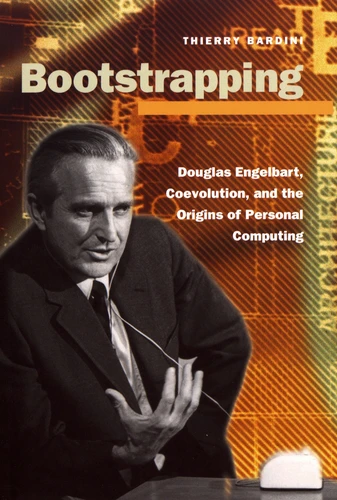
Bootstrapping. Douglas Engelbart, Coevolution, and the Origins of Personal Computing
Par :Formats :
- Nombre de pages284
- FormatGrand Format
- PrésentationBroché
- Poids0.449 kg
- Dimensions15,6 cm × 23,4 cm × 2,1 cm
- ISBN0-8047-3871-8
- EAN9780804738712
- Date de parution01/12/2000
- CollectionWriting Science
- ÉditeurStanford University Press
Résumé
Combining technological, social, and historical perspectives, Bootstrapping traces the genesis of personal computing through a close study of the pathbreaking work of one researcher, Douglas Engelbart. In his Institute in the 1960s, Engelbart, along with a small team of researchers, developed some of the cornerstones of personal computing as we know it - including the mouse, the windowed user interface, and hypertext.
Since that time, all these technologies have become so commonplace as to be taken for granted, but the assumptions and rnotivations behind their invention are not, Thierry Bardini analyzes Engelbart's singular achievement through a detailed history of his vision for a human-computer interface in the context of the US computer research community during the 1960s and 1970s. Engelbart felt that the complexity of many of the world's problems was becoming overwhelming, and the time for solving them increasing short.
What was needed. he determined, was a system to augment human intelligence, co-transforming or co-evolving both humans and the machines they use. He sought a systematic way to think and organize this coevolution in an effort to discover a path on which radical technological improvement could lead to radical improvements in people's capacities to work effectively. Engelbart's project involved not just the invention of a computerized system that would enable humans.
acting together, to manage complex, but the invention of a new kind of human, "the user." Ultimately he envisioned a "bootstrapping" process by which those who actually invented the hardware and software of this new system would simultaneously reinvent the human in a new form. The book offers a careful narrative of the growth and decline of Engelbart's laboratory at SRI, and it examines the subsequent translation of Engelbart's vision.
It shows that Engelbart's ultimate goal of coevolution came to be translated in the less challenging terms of technological progress and human adaptation to supposedly user-friendly technologies. At a time when the massive diffusion of the World Wide Web has spawned myriad pronouncements on our social and technological future, Bootstrapping recalls the early experiments and original ideals that led to today's "information revolution."
Since that time, all these technologies have become so commonplace as to be taken for granted, but the assumptions and rnotivations behind their invention are not, Thierry Bardini analyzes Engelbart's singular achievement through a detailed history of his vision for a human-computer interface in the context of the US computer research community during the 1960s and 1970s. Engelbart felt that the complexity of many of the world's problems was becoming overwhelming, and the time for solving them increasing short.
What was needed. he determined, was a system to augment human intelligence, co-transforming or co-evolving both humans and the machines they use. He sought a systematic way to think and organize this coevolution in an effort to discover a path on which radical technological improvement could lead to radical improvements in people's capacities to work effectively. Engelbart's project involved not just the invention of a computerized system that would enable humans.
acting together, to manage complex, but the invention of a new kind of human, "the user." Ultimately he envisioned a "bootstrapping" process by which those who actually invented the hardware and software of this new system would simultaneously reinvent the human in a new form. The book offers a careful narrative of the growth and decline of Engelbart's laboratory at SRI, and it examines the subsequent translation of Engelbart's vision.
It shows that Engelbart's ultimate goal of coevolution came to be translated in the less challenging terms of technological progress and human adaptation to supposedly user-friendly technologies. At a time when the massive diffusion of the World Wide Web has spawned myriad pronouncements on our social and technological future, Bootstrapping recalls the early experiments and original ideals that led to today's "information revolution."
A propos de Thierry Bardini

9,99 €


28,00 €