

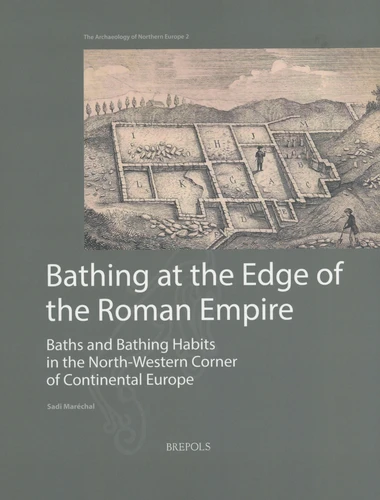
Bathing at the Edge of the Roman Empire. Baths and Bathing Habits in the North-Western Corner of Continental Europe
Par :Formats :
- Nombre de pages302
- FormatGrand Format
- PrésentationBroché
- Poids1.215 kg
- Dimensions21,5 cm × 28,0 cm × 2,0 cm
- ISBN978-2-503-60066-6
- EAN9782503600666
- Date de parution01/01/2023
- CollectionThe Archaeology of Northern Eu
- ÉditeurBrepols
Résumé
Roman bathhouses are considered to be prime marken when studying romanization in the provinces of the Empire, as these very specific - and archaeologically recognizable - buildings, together with their associated ideas about the body and personal health, ntroduced a decidely Roman habit into regions that had hitherto been unfamiliar with (communal) bathhouses and heating technology. While traditionally, studies into Roman baths and bathing havefocused on large public baths in the cities of the empire, however, those from the area that now roughly corresponds to modern-day Belgium have often been neglected in recent research as this was an area with few important urban centres.
This book for the first time investigates the introduction, spread, and eventual disappearance of Roman-style baths and of bathing habits in this north-western corner of the Roman Empire. A detailed analysis of the architecture, technology, and decoration of both public and private baths is combined with a discussion on the role of bathing in the area's romanization, and supplemented by a fully illustrated catalogue of all bathhouses in the area of study.
In doing so, the volume sheds new light not only on theevolution of baths and bathing in this region, but also on their broader role in larger historic processes such as cultural change across the Empire. The Archaeology of Northern Europe provides a dedicated forum for the publication of archaeological research from throughout Northern Europe, a region here defined as stretching from Ireland and the British Isles, via France, and the countries of the North Sea, up to Scandinavia and into the Baltic States, over a time period that spans from the Palaeolithic up to the Early Modern.
Through this broad geographical and chronological scope, it encourages research that looks beyond discrete divisions in chronology, culture, or region, and that seeks to examine the political, cultural, social, and economic ties that bound together - and divided - the lands and peoples of the North Atlantic North Sea, and Baltic. The series encompasses umber of different disciplines and area studies, incorporating both monographs and edited collections covering a range of fields, including archaeology, landscape and urban studies, environmental archaeology, material culture, iconography, and discussions of theoretical frameworks and their application.
This book for the first time investigates the introduction, spread, and eventual disappearance of Roman-style baths and of bathing habits in this north-western corner of the Roman Empire. A detailed analysis of the architecture, technology, and decoration of both public and private baths is combined with a discussion on the role of bathing in the area's romanization, and supplemented by a fully illustrated catalogue of all bathhouses in the area of study.
In doing so, the volume sheds new light not only on theevolution of baths and bathing in this region, but also on their broader role in larger historic processes such as cultural change across the Empire. The Archaeology of Northern Europe provides a dedicated forum for the publication of archaeological research from throughout Northern Europe, a region here defined as stretching from Ireland and the British Isles, via France, and the countries of the North Sea, up to Scandinavia and into the Baltic States, over a time period that spans from the Palaeolithic up to the Early Modern.
Through this broad geographical and chronological scope, it encourages research that looks beyond discrete divisions in chronology, culture, or region, and that seeks to examine the political, cultural, social, and economic ties that bound together - and divided - the lands and peoples of the North Atlantic North Sea, and Baltic. The series encompasses umber of different disciplines and area studies, incorporating both monographs and edited collections covering a range of fields, including archaeology, landscape and urban studies, environmental archaeology, material culture, iconography, and discussions of theoretical frameworks and their application.