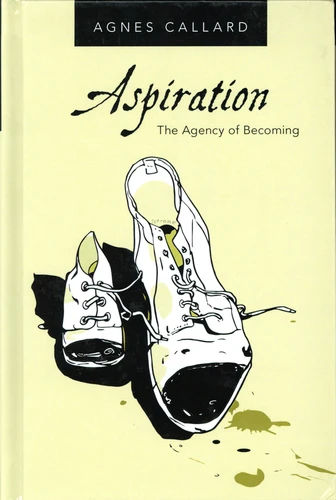
Advance praise for Aspiration : "Agnes Callard develops and defends a fascinating new idea about aspiration, the form of agency involving the rational process by which we work to care about something new. For Callard, aspiring agents exhibit a distinctive form of rationality that is not a matter of decision-making at all. Choosing to undergo a personal revolution is, rather, aspiring to a certain type of self-change.
Deep and broad in its philosophical reach, the book makes a major contribution to our understanding of practical rationality and moral psychology." L. A. Paul, Department of Philosophy, University of North Carolina, Chapel Hill, author of Transformative Experience (OUP). "A superb, agenda-setting addition to recent philosophical investigations into "transformative experience", the kind of experience that results in changes to one's basic values.
Callard rightly singles out "aspiration" - a change in one's values that, she argues, is rationally guided by what those values will become - as a critically important species of such experience, and brings out, with clarity, insight, and brilliance, the deep connections between this phenomenon and a range of other central topics in moral psychology and the theory of practical reasoning, such as the nature of moral responsibility, internalism about reasons, and akrasia." Ned Hall, Department of Philosophy, Harvard University.
Advance praise for Aspiration : "Agnes Callard develops and defends a fascinating new idea about aspiration, the form of agency involving the rational process by which we work to care about something new. For Callard, aspiring agents exhibit a distinctive form of rationality that is not a matter of decision-making at all. Choosing to undergo a personal revolution is, rather, aspiring to a certain type of self-change.
Deep and broad in its philosophical reach, the book makes a major contribution to our understanding of practical rationality and moral psychology." L. A. Paul, Department of Philosophy, University of North Carolina, Chapel Hill, author of Transformative Experience (OUP). "A superb, agenda-setting addition to recent philosophical investigations into "transformative experience", the kind of experience that results in changes to one's basic values.
Callard rightly singles out "aspiration" - a change in one's values that, she argues, is rationally guided by what those values will become - as a critically important species of such experience, and brings out, with clarity, insight, and brilliance, the deep connections between this phenomenon and a range of other central topics in moral psychology and the theory of practical reasoning, such as the nature of moral responsibility, internalism about reasons, and akrasia." Ned Hall, Department of Philosophy, Harvard University.