

Harry Percival has been a Python programmer and fan of TDD and XP since 2009. He's the author of Test-Driven Development with Python from O'Reilly, better known by its subtitle, Obey the Testing Goot. Bob Gregory has been building event-driven systems using domain-driven design for more than a decade. in languages including CC, FC. Python, and Typescript.
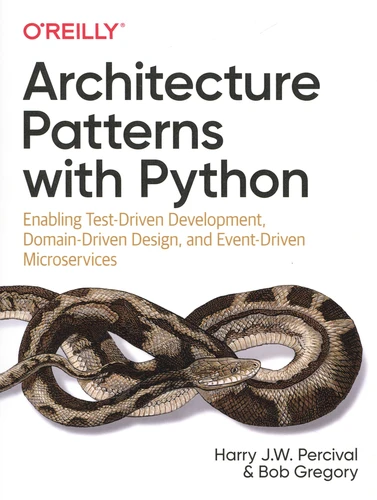
Architecture Patterns with Python. Enabling Test-Driven Development, Domain-Driven Design, and Event-Driven Microservices
Par : ,Formats :
- Paiement en ligne :
- Livraison à domicile ou en point Mondial Relay estimée à partir du 4 janvierCet article sera commandé chez un fournisseur et vous sera envoyé 127 jours après la date de votre commande.
- Retrait Click and Collect en magasin gratuit
- Nombre de pages275
- FormatGrand Format
- PrésentationBroché
- Poids0.531 kg
- Dimensions17,7 cm × 23,3 cm × 2,0 cm
- ISBN978-1-4920-5220-3
- EAN9781492052203
- Date de parution30/04/2020
- ÉditeurO'Reilly
Résumé
As Python continues to grow in popularity, projects are becoming larger and more complex. Many Python developers are taking an interest in high-level software design patterns such as hexagonal/clean architecture, event-driven architecture, and the strategic patterns prescribed by domain-driven design (DDD). But translating those patterns into Python isn't always straightforward. With this hands-on guide.
Harry Percival and Bob Gregory from MADE.com introduce proven architectural design patterns to help Python developers manage application complexity—and get the most value out of their test suites. Each pattern is illustrated with concrete examples in beautiful, idiomatic Python, avoiding some of the verbosity of Java and CC syntax. Patterns include : Dependency inversion and its links to ports and adapters (hexagonal/clean architecture) ; Domain-driven design's distinction between Entities, Value Objects, and Aggregates ; Repository and Unit of Work patterns for persistent storage ; Events, commands, and the message bus ; Command-query responsibility segregation (CQRS) ; Event-driven architecture and reactive microservices
Harry Percival and Bob Gregory from MADE.com introduce proven architectural design patterns to help Python developers manage application complexity—and get the most value out of their test suites. Each pattern is illustrated with concrete examples in beautiful, idiomatic Python, avoiding some of the verbosity of Java and CC syntax. Patterns include : Dependency inversion and its links to ports and adapters (hexagonal/clean architecture) ; Domain-driven design's distinction between Entities, Value Objects, and Aggregates ; Repository and Unit of Work patterns for persistent storage ; Events, commands, and the message bus ; Command-query responsibility segregation (CQRS) ; Event-driven architecture and reactive microservices