SOLDES
Jusqu'à -70% sur une sélection d'articles*


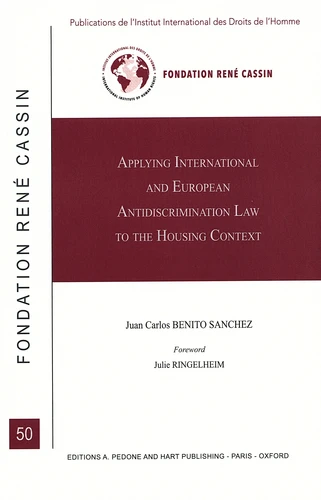
Applying International and European Antidiscrimination Law to the Housing Context
Par :Formats :
- Paiement en ligne :
- Livraison à domicile ou en point Mondial Relay estimée à partir du 12 novembreCet article sera commandé chez un fournisseur et vous sera envoyé 127 jours après la date de votre commande.
- Retrait Click and Collect en magasin gratuit
- Livraison à domicile ou en point Mondial Relay estimée à partir du 12 novembre
- Réservation en ligne avec paiement en magasin :
- Indisponible pour réserver et payer en magasin
- Nombre de pages250
- FormatGrand Format
- PrésentationBroché
- Poids0.36 kg
- Dimensions15,5 cm × 24,0 cm × 1,2 cm
- ISBN978-2-233-01038-4
- EAN9782233010384
- Date de parution01/03/2023
- CollectionInstitut droits de l'homme
- ÉditeurPedone
- PréfacierJulie Ringelheim
Résumé
The central argument of this book is that the application of antidiscrimination law to the field of housing complements and enriches a right to adequate housing approach in two ways : firstly, it helps to elaborate and expand the rationale and implications of certain components of the right to housing ; secondly, it allows us to address human rights concerns that cannot be adequately tackled through the right to housing alone.
I reach this conclusion through an analysis of the conceptual and practical implications arising from the application of antidiscrimination norms to the housing context, with a focus on Europe. An enquiry into the philosophical foundations of antidiscrimination law leads me to identify four aims that antidiscrimination norms ought to pursue : eliminating hostility, prejudice, and stigma ; respecting cultural diversity and avoiding misrecognition ; transforming existing structures ; and ensuring a fair distribution of important goods in society.
Applying this framework to the field of housing, I find that various antidiscrimination legal concepts can be mobilised to achieve those four aims, among which direct and indirect discrimination, discriminatory harassment, and reasonable accommodation. I also defend the usefulness of incorporating and mobilising socioeconomic disadvantage as a prohibited ground of discrimination to this end. I then build on two case studies—housing segregation, on the one hand ; housing commodi-fication and financialisation, on the other hand—to further demonstrate the contribution of antidiscrimination law to specific housing issues.
Finally, I propose several procedural and substantive avenues to achieve diversity-conscious, all-inclusive housing policies, looking in particular at equality duties and housing decommodification policies. The legal analysis developed throughout this book, based on a human rights law methodology, is enriched through references to political and legal philosophy and to urban sociology.
I reach this conclusion through an analysis of the conceptual and practical implications arising from the application of antidiscrimination norms to the housing context, with a focus on Europe. An enquiry into the philosophical foundations of antidiscrimination law leads me to identify four aims that antidiscrimination norms ought to pursue : eliminating hostility, prejudice, and stigma ; respecting cultural diversity and avoiding misrecognition ; transforming existing structures ; and ensuring a fair distribution of important goods in society.
Applying this framework to the field of housing, I find that various antidiscrimination legal concepts can be mobilised to achieve those four aims, among which direct and indirect discrimination, discriminatory harassment, and reasonable accommodation. I also defend the usefulness of incorporating and mobilising socioeconomic disadvantage as a prohibited ground of discrimination to this end. I then build on two case studies—housing segregation, on the one hand ; housing commodi-fication and financialisation, on the other hand—to further demonstrate the contribution of antidiscrimination law to specific housing issues.
Finally, I propose several procedural and substantive avenues to achieve diversity-conscious, all-inclusive housing policies, looking in particular at equality duties and housing decommodification policies. The legal analysis developed throughout this book, based on a human rights law methodology, is enriched through references to political and legal philosophy and to urban sociology.