

Richard L. Kremer is emeritus professor of history at Dartmouth College and associate and reviews editor of the Journal for the History of Astronomy. Matthieu Husson is a researcher in the history of late medieval astronomy in Europe and is the PI of the ERC project ALFA based at the Paris Observatory. José Chabás is emeritus professor at Pompeu Fabra Universitat, Barcelona. and has authored several monographs on the history of astronomy.
Alfonsine Astonomy. The Written Record
Par : , ,Formats :
- Nombre de pages426
- FormatGrand Format
- PrésentationRelié
- Poids1.03 kg
- Dimensions18,3 cm × 26,2 cm × 3,1 cm
- ISBN978-2-503-59520-7
- EAN9782503595207
- Date de parution01/01/2020
- ÉditeurBrepols
Résumé
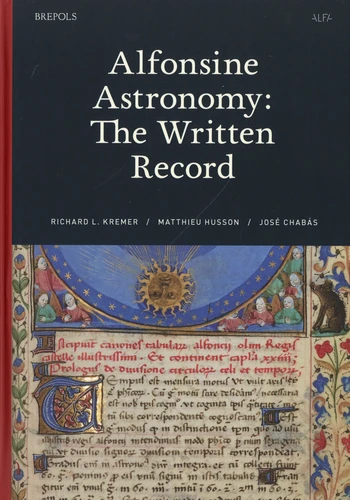
Compiled between 1262 and 1272 in Toledo under the patronage of Alfonso X, the Castilian Alfonsine Tables were recast in Paris in the 1320s, resulting in what we now call the Parisian Alfonsine Tables. These materials circulated widely and fostered astronomical activities throughout Europe. This resulted in a significant number of new works, of which there are a few hundred, extant in more than 900 manuscript codices and dozens of printed editions.
These manuscripts and imprints, broadly contemporary to the works they witness, comprise the written record of Alfonsine astronomy and provide the focus of this volume. A first series of essays examines individual manuscripts containing Alfonsine works. The authors seek to reconstruct, from the manuscript evidence, the cultural, astronomical and mathematical worlds in which the manuscripts were initially copied, compiled, used and collected.
A second series of essays turns from the particular codex to the individual work or author. These contributions ask how particular works have been transmitted in surviving manuscript witnesses and how broader manuscript cultures sháped the diffusion, over two cepturies, of Alfonsine astronomy across Europe. A final essay reflects on the challenges and opportunities offered by digital humanities approaches in such collective studies of a large manuscript corpus.
These manuscripts and imprints, broadly contemporary to the works they witness, comprise the written record of Alfonsine astronomy and provide the focus of this volume. A first series of essays examines individual manuscripts containing Alfonsine works. The authors seek to reconstruct, from the manuscript evidence, the cultural, astronomical and mathematical worlds in which the manuscripts were initially copied, compiled, used and collected.
A second series of essays turns from the particular codex to the individual work or author. These contributions ask how particular works have been transmitted in surviving manuscript witnesses and how broader manuscript cultures sháped the diffusion, over two cepturies, of Alfonsine astronomy across Europe. A final essay reflects on the challenges and opportunities offered by digital humanities approaches in such collective studies of a large manuscript corpus.