

Mr. Hubert Rodarie is the Chairman of the French Association of Institutional Investors (Af2i). As he is an investment professional, he has led asset management companies and for eighteen years deputy CEO of a French insurance group. As a scientist, he has written numerous articles and contributions, as well as two books on economic and monetary issues and financial regulation, one of which received the DFCG-Turgot Award.
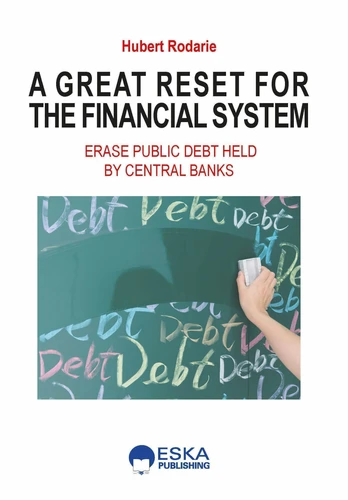
A great reset for the financial system. Erase public debt held by central banks
Par :Formats :
- Paiement en ligne :
- Livraison à domicile ou en point Mondial Relay estimée à partir du 17 septembreCet article sera commandé chez un fournisseur et vous sera envoyé 25 jours après la date de votre commande.
- Retrait Click and Collect en magasin gratuit
- Réservation en ligne avec paiement en magasin :
- Indisponible pour réserver et payer en magasin
- Nombre de pages196
- FormatGrand Format
- PrésentationBroché
- Poids0.335 kg
- Dimensions14,8 cm × 20,8 cm × 1,3 cm
- ISBN978-2-7472-3100-8
- EAN9782747231008
- Date de parution28/04/2021
- ÉditeurEska (Editions)
Résumé
Today, public debt is haunting political debates. After the COVID-19 shock on the world economy, public debt has risen sharply. It is unlikely to ever be repaid. What is happening ? Have we lost our minds ? How can we lend if we know we will never be repaid ? It is the answer to this simple question that will break the deadlock in which the world economy has been stuck for 20 years. With, in the end, always more debt for less growth.
To answer this question, this book starts from the observation that public debt is not the same kind of debt that ordinary people can contract among themselves or with their banks, even if the words and legal forms used are the same. Indeed, public debt is above all a particular form of money, because money, like public debt, is above all a credit on all citizens. The money we use is also an acknowledgement of debt.
We cannot therefore reason about public debt by making analogies with private debt. The substance of the subject should not be confused with the usual conventional forms. Because it's also money, public debt can be cancelled without destabilizing the activity. Fortunately, because this measure is necessary to unblock political and economic actors, but the prosperity desired by all requires real monetary reforms and reforms of the international monetary system to eliminate the inexorable trend of indebtedness observed over the last 40 years : we need a great reset for the financial system.
To answer this question, this book starts from the observation that public debt is not the same kind of debt that ordinary people can contract among themselves or with their banks, even if the words and legal forms used are the same. Indeed, public debt is above all a particular form of money, because money, like public debt, is above all a credit on all citizens. The money we use is also an acknowledgement of debt.
We cannot therefore reason about public debt by making analogies with private debt. The substance of the subject should not be confused with the usual conventional forms. Because it's also money, public debt can be cancelled without destabilizing the activity. Fortunately, because this measure is necessary to unblock political and economic actors, but the prosperity desired by all requires real monetary reforms and reforms of the international monetary system to eliminate the inexorable trend of indebtedness observed over the last 40 years : we need a great reset for the financial system.
A propos de Hubert Rodarie

L'Europe face à Trump. Comment relever le défi
Grand Format
22,00 €


19,99 €