

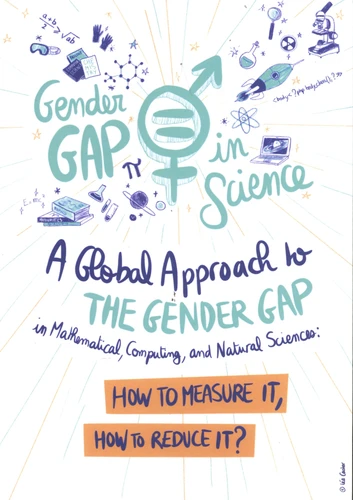
A Global Approach to the Gender Gap in Mathematical, Computing, and Natural Sciences. How to Measure It, How to Reduce It?
Par : ,Formats :
- Nombre de pages239
- FormatGrand Format
- PrésentationBroché
- Poids0.325 kg
- Dimensions14,7 cm × 20,9 cm × 1,5 cm
- ISBN978-3-00-065533-3
- EAN9783000655333
- Date de parution06/06/2020
- ÉditeurHKS München
Résumé
This book reports on a three-year project (2017-2019) funded by the International Science Council and involving eleven scientific partner organizations. The main goal of the project was to investigate the gender gap in STEM disciplines from different angles, globally and across disciplines. We have performed (i) a global survey of scientists with more than 32 000 responses ; (ii) an investigation of the effect of gender in millions of scientific publications ; and (iii) the compilation of best-practice initiatives that address the gender gap in Mathematical, Computing, and Natural Sciences at various levels.
We conclude that the gender gap is very real in science and mathematics. We present methodologies, insights, and tools that have been developed throughout the project, as well as a set of recommendations for different audiences : instructors and parents ; educational institutions ; scientific unions and other organizations responsible for science policy.
We conclude that the gender gap is very real in science and mathematics. We present methodologies, insights, and tools that have been developed throughout the project, as well as a set of recommendations for different audiences : instructors and parents ; educational institutions ; scientific unions and other organizations responsible for science policy.