
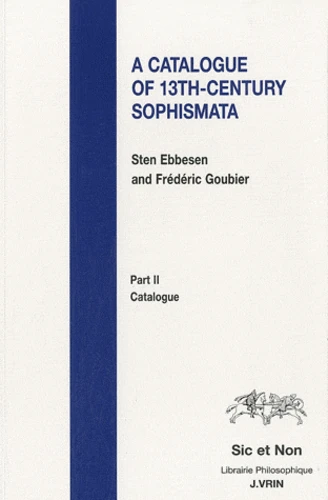
A Catalogue of 13th-Century Sophismata. Part 2, Catalogue
Par : ,Formats :
Expédié sous 127 jours
Cet article sera commandé chez un fournisseur et vous sera envoyé 127 jours après la date de votre commande.
- Paiement en ligne :
- Livraison à domicile ou en point Mondial Relay estimée à partir du 2 novembreCet article sera commandé chez un fournisseur et vous sera envoyé 127 jours après la date de votre commande.
- Retrait Click and Collect en magasin gratuit
- Livraison à domicile ou en point Mondial Relay estimée à partir du 2 novembre
- Réservation en ligne avec paiement en magasin :
- Indisponible pour réserver et payer en magasin
- Nombre de pages1024
- PrésentationBroché
- Poids1.03 kg
- Dimensions24,0 cm × 16,0 cm × 6,4 cm
- ISBN978-2-7116-2313-6
- EAN9782711623136
- Date de parution01/09/2010
- CollectionSic et Non
- ÉditeurVrin
Résumé
In the terminology of the medieval faculties of arts a sophisma was a proposition that produced problems for logic or grammar because, apparently, it could be shown to be both true and false or both grammatically correct and incorrect. Analysis of sophismata played a major role in university teaching, and a rich literature reflecting this practice is still preserved. This catalogue offers the first ever opportunity to orient oneself in the jungle of 13th-century texts on sophismata, edited and unedited alike.
It lists and describes every single collection, but also, importantly, in an alphabetical catalogue of sophismatic propositions, under each lists every occurrence of it in the corpus, with information about where each occurrence is found in manuscripts or editions, the syncategoreme to which it belongs, the kind of analysis it displays, what is the solution offered, and which questions, if any, receive special attention in quaestiones/problemata, an incipit and an explicit where there is no edition available, and finally, what secondary literature there is, if any.
Some 3. 000 entries make up the body of the catalogue, which is completed by extensive indices by topics and by logical tools used in the solutions, offering scholars a multiplicity of ways to find exactly the information they are looking for.
It lists and describes every single collection, but also, importantly, in an alphabetical catalogue of sophismatic propositions, under each lists every occurrence of it in the corpus, with information about where each occurrence is found in manuscripts or editions, the syncategoreme to which it belongs, the kind of analysis it displays, what is the solution offered, and which questions, if any, receive special attention in quaestiones/problemata, an incipit and an explicit where there is no edition available, and finally, what secondary literature there is, if any.
Some 3. 000 entries make up the body of the catalogue, which is completed by extensive indices by topics and by logical tools used in the solutions, offering scholars a multiplicity of ways to find exactly the information they are looking for.