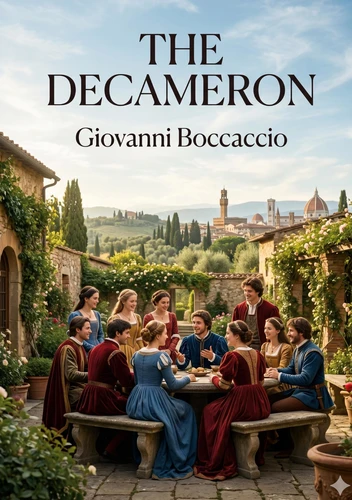
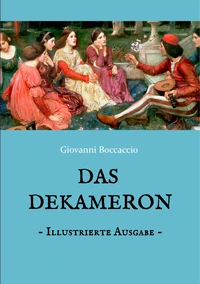
The Decameron, written in the mid-14th century by Giovanni Boccaccio, remains one of the most influential works of Western literature. This foundational masterpiece of Italian prose is structured as a frame narrative : as the Black Death ravages Florence in 1348, a group of seven young women and three young men seek refuge in a secluded villa in the countryside. To pass the time and maintain their spirits, they agree to tell one story each per night for ten days, resulting in a collection of 100 novellas.
Boccaccio's work is a vivid tapestry of medieval life, breaking away from the rigid theological structures of the time to celebrate the human experience in all its complexity. The tales span a vast emotional and moral range-from ribald comedy and sharp-witted trickery to tragic romance and profound ethical dilemmas. Unlike the courtly literature of the era, The Decameron focuses on the merchant class, the clergy, and the peasantry, offering a realistic (though often satirical) look at social dynamics, gender roles, and the unpredictability of Fortune.
The structural brilliance of the work lies in its thematic organization ; each day is governed by a "king" or "queen" who chooses the topic, such as "tales of love that ended unhappily" or "the power of human wit". This variety allowed Boccaccio to explore the full breadth of human nature-virtue, vice, desire, and survival. Historically, The Decameron is credited with elevating the vernacular Italian language to a literary status previously reserved for Latin, directly influencing later giants like Geoffrey Chaucer and William Shakespeare.
This edition provides readers with a faithful preservation of Boccaccio's sharp irony and narrative flow. It serves as both an essential historical document of the post-Plague era and a timeless exploration of the stories we tell to survive dark times. Whether read for its historical importance or its sheer entertainment value, The Decameron continues to resonate as a powerful tribute to human resilience and the enduring power of the written word.
The Decameron, written in the mid-14th century by Giovanni Boccaccio, remains one of the most influential works of Western literature. This foundational masterpiece of Italian prose is structured as a frame narrative : as the Black Death ravages Florence in 1348, a group of seven young women and three young men seek refuge in a secluded villa in the countryside. To pass the time and maintain their spirits, they agree to tell one story each per night for ten days, resulting in a collection of 100 novellas.
Boccaccio's work is a vivid tapestry of medieval life, breaking away from the rigid theological structures of the time to celebrate the human experience in all its complexity. The tales span a vast emotional and moral range-from ribald comedy and sharp-witted trickery to tragic romance and profound ethical dilemmas. Unlike the courtly literature of the era, The Decameron focuses on the merchant class, the clergy, and the peasantry, offering a realistic (though often satirical) look at social dynamics, gender roles, and the unpredictability of Fortune.
The structural brilliance of the work lies in its thematic organization ; each day is governed by a "king" or "queen" who chooses the topic, such as "tales of love that ended unhappily" or "the power of human wit". This variety allowed Boccaccio to explore the full breadth of human nature-virtue, vice, desire, and survival. Historically, The Decameron is credited with elevating the vernacular Italian language to a literary status previously reserved for Latin, directly influencing later giants like Geoffrey Chaucer and William Shakespeare.
This edition provides readers with a faithful preservation of Boccaccio's sharp irony and narrative flow. It serves as both an essential historical document of the post-Plague era and a timeless exploration of the stories we tell to survive dark times. Whether read for its historical importance or its sheer entertainment value, The Decameron continues to resonate as a powerful tribute to human resilience and the enduring power of the written word.