
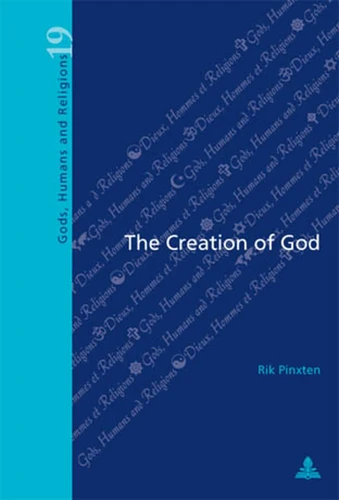
The Creation of God
Par :Formats :
- Paiement en ligne :
- Livraison à domicile ou en point Mondial Relay estimée à partir du 19 aoûtCet article sera commandé chez un fournisseur et vous sera envoyé 21 jours après la date de votre commande.
- Retrait Click and Collect en magasin gratuit
- Livraison à domicile ou en point Mondial Relay estimée à partir du 19 août
- Réservation en ligne avec paiement en magasin :
- Indisponible pour réserver et payer en magasin
- Nombre de pages252
- PrésentationBroché
- Poids0.348 kg
- Dimensions22,0 cm × 15,0 cm × 1,4 cm
- ISBN90-5201-644-5
- EAN9789052016443
- Date de parution22/09/2005
- CollectionPLG.HUMANITIES
- ÉditeurPeter Lang AG
Résumé
This book develops a scientific approach to the phenomenon of religion. It is the conviction of the author that such an approach can only be comparative in nature, in order to overcome centuries of religiously biased views on religion. From an anthropological point of view the phenomenological school of thought is intrinsically religionistic (i.e., influenced by a particular religious frame of reference).
The author formulates a model which seeks to distinguish between three irreducible religious ways (ritualistic, mythagogic and shamanistic), of which religious forms at the object level are composed. The typical characteristics of religion in the theories of the religions of the book then appear as specific (‘local') formats, next to and at the same level as any other religious manifestation in the world.
In a second hypothesis in the book, the primacy of action over language for the human species is argued for. Here again, a local preference for verbal actions is identified in the religions of the book. To develop a more generic view on religion, the author proposes to look at humans first and foremost as acting subjects, with verbal actions as a subcategory.
The author formulates a model which seeks to distinguish between three irreducible religious ways (ritualistic, mythagogic and shamanistic), of which religious forms at the object level are composed. The typical characteristics of religion in the theories of the religions of the book then appear as specific (‘local') formats, next to and at the same level as any other religious manifestation in the world.
In a second hypothesis in the book, the primacy of action over language for the human species is argued for. Here again, a local preference for verbal actions is identified in the religions of the book. To develop a more generic view on religion, the author proposes to look at humans first and foremost as acting subjects, with verbal actions as a subcategory.