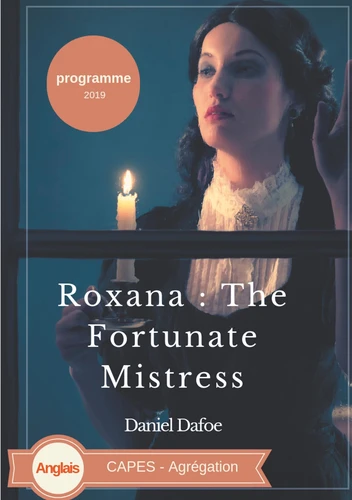
Roxana : The Fortunate Mistress (full title : The Fortunate Mistress : Or, A History of the Life and Vast Variety of Fortunes of Mademoiselle de Beleau, Afterwards Called the Countess de Wintselsheim, in Germany, Being the Person known by the Name of the Lady Roxana, in the Time of King Charles II) is a 1724 novel by Daniel Defoe. The novel examines the possibility of eighteenth-century women owning their own estate despite a patriarchal society, as with Roxana's celebrated claim that "the Marriage Contract is ...
nothing but giving up Liberty, Estate, Authority, and everything, to the Man".The novel further draws attention to the incompatibility between sexual freedom and freedom from motherhood : Roxana becomes pregnant many times due to her sexual exploits, and it is one of her children, Susan, who come back to expose her, years later, near the novel's close, helping to precipitate her flight abroad, subsequent loss of wealth, and (ambiguous) repentance.
The character of Roxana can be described as a proto-feminist because she carries out her actions of prostitution for her own ends of freedom but before a feminist ideology was fully formed, (though Defoe also works to undercut the radicalism of her position). The book also explores the clash of values between the Restoration court and the middle-class. Roxana also discusses the issues of truth and deceit.
As the text is a first-person narration and written to simulate a real first-hand account of a woman, first comes the issue of subjectivity, but also the underlying lie as to the veracity of the text. The reader can only trust in Roxana to give us a true account of her story, but as she often lies to other characters in the book, and even to herself, she is not a reliable narrator. Furthermore, the whole construction of her character is made on lies and disguises.
Her name, or names, are not mentioned until the end of the novel, so even the most basic aspect of her identity - her name - is a mystery for the majority of the novel. And the name that is most associated to her : Roxana, is based on a lie and on a disguise, namely the Turkish dress. Published anonymously, and not attributed to Defoe till 1775, Roxana was nonetheless a popular hit in the eighteenth century, frequently reprinted in altered versions to suit the taste of the day : thus the 1775 edition, which called itself The New Roxana, had been sentimentalised to meet the tastes of the day.
Roxana : The Fortunate Mistress (full title : The Fortunate Mistress : Or, A History of the Life and Vast Variety of Fortunes of Mademoiselle de Beleau, Afterwards Called the Countess de Wintselsheim, in Germany, Being the Person known by the Name of the Lady Roxana, in the Time of King Charles II) is a 1724 novel by Daniel Defoe. The novel examines the possibility of eighteenth-century women owning their own estate despite a patriarchal society, as with Roxana's celebrated claim that "the Marriage Contract is ...
nothing but giving up Liberty, Estate, Authority, and everything, to the Man".The novel further draws attention to the incompatibility between sexual freedom and freedom from motherhood : Roxana becomes pregnant many times due to her sexual exploits, and it is one of her children, Susan, who come back to expose her, years later, near the novel's close, helping to precipitate her flight abroad, subsequent loss of wealth, and (ambiguous) repentance.
The character of Roxana can be described as a proto-feminist because she carries out her actions of prostitution for her own ends of freedom but before a feminist ideology was fully formed, (though Defoe also works to undercut the radicalism of her position). The book also explores the clash of values between the Restoration court and the middle-class. Roxana also discusses the issues of truth and deceit.
As the text is a first-person narration and written to simulate a real first-hand account of a woman, first comes the issue of subjectivity, but also the underlying lie as to the veracity of the text. The reader can only trust in Roxana to give us a true account of her story, but as she often lies to other characters in the book, and even to herself, she is not a reliable narrator. Furthermore, the whole construction of her character is made on lies and disguises.
Her name, or names, are not mentioned until the end of the novel, so even the most basic aspect of her identity - her name - is a mystery for the majority of the novel. And the name that is most associated to her : Roxana, is based on a lie and on a disguise, namely the Turkish dress. Published anonymously, and not attributed to Defoe till 1775, Roxana was nonetheless a popular hit in the eighteenth century, frequently reprinted in altered versions to suit the taste of the day : thus the 1775 edition, which called itself The New Roxana, had been sentimentalised to meet the tastes of the day.