OFFRE LISEUSES
Une liseuse achetée = une housse offerte* jusqu'au 21 juin

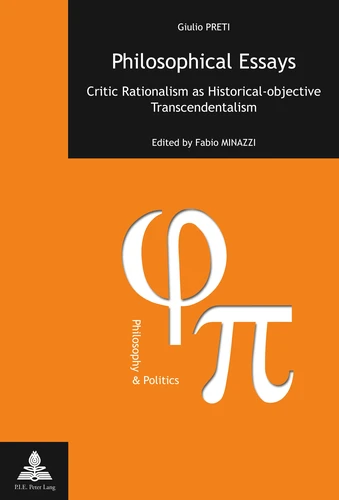
Philosophical Essays. Critic Rationalism as Historical-objective Transcendentalism- Edited by Fabio Minazzi- Translation from Italian by Richard Sadleir
Par :Formats :
Expédié sous 21 jours
Cet article sera commandé chez un fournisseur et vous sera envoyé 21 jours après la date de votre commande.
- Paiement en ligne :
- Livraison à domicile ou en point Mondial Relay estimée à partir du 16 juilletCet article sera commandé chez un fournisseur et vous sera envoyé 21 jours après la date de votre commande.
- Retrait Click and Collect en magasin gratuit
- Livraison à domicile ou en point Mondial Relay estimée à partir du 16 juillet
- Réservation en ligne avec paiement en magasin :
- Indisponible pour réserver et payer en magasin
- Nombre de pages326
- PrésentationBroché
- Poids0.444 kg
- Dimensions22,0 cm × 15,0 cm × 1,8 cm
- ISBN978-90-5201-778-5
- EAN9789052017785
- Date de parution28/10/2009
- CollectionPLG.HUMANITIES
- ÉditeurPeter Lang AG
Résumé
These Philosophical Essays by Giulio Preti explore, with particular acuteness and originality, some of the major problems addressed by contemporary philosophy. Preti's objective was to outline a "scientific" philosophy capable of embodying the rigour and concern for the factual found in scientific procedure. His analysis engaged with the complex tradition of logical empiricism and he also devoted attention to pragmatism and the philosophy of praxis in early Marx.
Preti succeeded in establishing a dialogue with these traditions of thought while also considering both Husserl's early phenomenology and the methodical approach derived from Kantian and neo-Kantian transcendentalism. He used this wide range of theoretical and practical horizons in innovative ways, presenting a critical metareflection receptive to these varying positions. In doing so Preti developed a new critical rationalism that incorporated a historical-objective transcendentalism.
Preti succeeded in establishing a dialogue with these traditions of thought while also considering both Husserl's early phenomenology and the methodical approach derived from Kantian and neo-Kantian transcendentalism. He used this wide range of theoretical and practical horizons in innovative ways, presenting a critical metareflection receptive to these varying positions. In doing so Preti developed a new critical rationalism that incorporated a historical-objective transcendentalism.