

Oliver Wendell Holmes Jr. dit The Great Dissenter, né le 8 mars 1841 à Boston dans le Massachusetts, mort le 6 mars 1935 à Washington est un juriste américain qui fut nommé par le président Theodore Roosevelt et confirmé par le Sénat juge à la Cour suprême des États-Unis de 1902 à 1932.
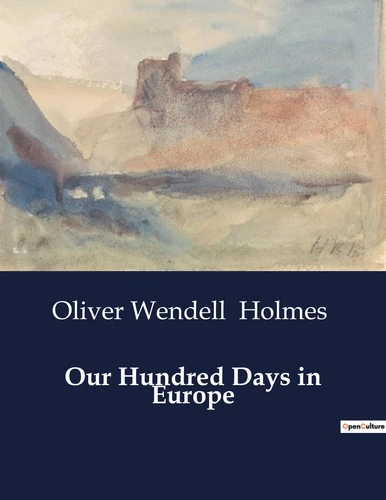
Our Hundred Days in Europe. A Journey Through Time: Revisiting Europe After Half a Century
Par :Formats :
- Paiement en ligne :
- Livraison à domicile ou en point Mondial Relay estimée à partir du 4 septembreCet article sera commandé chez un fournisseur et vous sera envoyé 21 jours après la date de votre commande.
- Retrait Click and Collect en magasin gratuit
- Réservation en ligne avec paiement en magasin :
- Indisponible pour réserver et payer en magasin
- Nombre de pages118
- PrésentationBroché
- Poids0.22 kg
- Dimensions17,0 cm × 22,0 cm × 0,9 cm
- ISBN979-10-419-8398-8
- EAN9791041983988
- Date de parution31/01/2024
- ÉditeurCulturea
Résumé
"Our Hundred Days in Europe" by Oliver Wendell Holmes is a reflective travelogue documenting the author's return to Europe after more than fifty years. Holmes, accompanied by his daughter, embarks on a journey that revisits the places he once explored as a young medical student. The narrative begins with their departure from Boston and the challenges faced during the sea voyage, including Holmes's struggle with asthma.
Upon arrival in England, they are greeted with a flurry of social invitations, highlighting the author's esteemed reputation. Holmes provides vivid descriptions of the English landscape, noting the well-groomed countryside and the rosy complexions of the children. The journey takes them to various iconic locations, including Chester, Eaton Hall, and London, where they engage in numerous social events, from breakfasts to grand receptions.
Holmes reflects on the changes in society and technology since his last visit, offering insights into the cultural and social dynamics of the time. The narrative is interspersed with personal anecdotes, historical references, and Holmes's observations on the differences between his past and present experiences. The travelogue not only captures the essence of Victorian England but also serves as a meditation on the passage of time and the enduring nature of human connections.
Upon arrival in England, they are greeted with a flurry of social invitations, highlighting the author's esteemed reputation. Holmes provides vivid descriptions of the English landscape, noting the well-groomed countryside and the rosy complexions of the children. The journey takes them to various iconic locations, including Chester, Eaton Hall, and London, where they engage in numerous social events, from breakfasts to grand receptions.
Holmes reflects on the changes in society and technology since his last visit, offering insights into the cultural and social dynamics of the time. The narrative is interspersed with personal anecdotes, historical references, and Holmes's observations on the differences between his past and present experiences. The travelogue not only captures the essence of Victorian England but also serves as a meditation on the passage of time and the enduring nature of human connections.
A propos de Oliver wendell Holmes

5,49 €

The Island Hunting-Song (Unabridged)
Audiobook
5,49 €

5,49 €

Elsie Venner (Unabridged)
Audiobook
5,49 €

The One-hoss Shay (Unabridged)
Audiobook
4,22 €