Odette Jankowitsch-Prevor is a consultant working for the International Atomic Energy Agency and a distinguished expert and lecturer in general nuclear law Quentin Michel is director of the European Studies Unit in the Department of Political Science at the University of Liège (Belgium). Sylvain Paile-Calvo is a senior researcher in the European Studies Unit in the Department of Political Science at the University of Liège (Belgium).
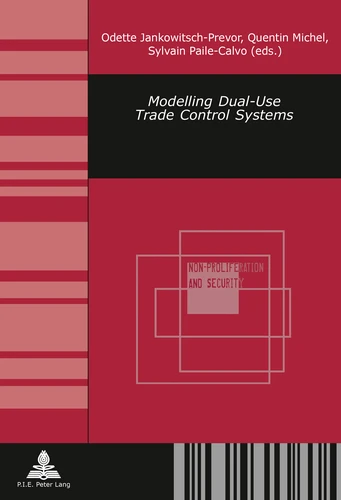
Modelling Dual-Use Trade Control Systems
Par : , ,Formats :
- Nombre de pages262
- PrésentationBroché
- Poids0.362 kg
- Dimensions22,0 cm × 15,0 cm × 1,4 cm
- ISBN978-2-87574-203-2
- EAN9782875742032
- Date de parution15/06/2016
- CollectionPLG.HUMANITIES
- ÉditeurPeter Lang AG
Résumé
The Chaudfontaine Group was established in 2010 as an annual two-day gathering of young Europeans with diverse academic backgrounds, including lawyers, economists and political scientists, from relevant national authorities, European institutions, scientific centres and industry. Its members are invited to discuss their respective viewpoints on the European trade of sensitive goods, focusing on the strategic issues confronting this sector in a rapidly evolving international context.
In December 2013, at its fourth conference, the Group met with African experts to debate the question of how African countries control the trade of dual-use items and the challenges they face in their search for effective regulations. The objective was to study whether international norms and experiences, pertaining both to states and to organisations, could be used as standardised models for African countries affected by unique security concerns.
This volume analyses and discusses those trade control systems which could be described as "models" and might therefore serve as a standard to be exported to the African countries in question. The debate is multi-levelled and studies the possibility of setting universal, regional or even-sub-regional norms. The contributors to this book, who display a wide variety of expertise, call for the adoption of norms which they argue have the potential to reconcile freedom of trade with international security, without presuming that these norms should be universal.
In December 2013, at its fourth conference, the Group met with African experts to debate the question of how African countries control the trade of dual-use items and the challenges they face in their search for effective regulations. The objective was to study whether international norms and experiences, pertaining both to states and to organisations, could be used as standardised models for African countries affected by unique security concerns.
This volume analyses and discusses those trade control systems which could be described as "models" and might therefore serve as a standard to be exported to the African countries in question. The debate is multi-levelled and studies the possibility of setting universal, regional or even-sub-regional norms. The contributors to this book, who display a wide variety of expertise, call for the adoption of norms which they argue have the potential to reconcile freedom of trade with international security, without presuming that these norms should be universal.