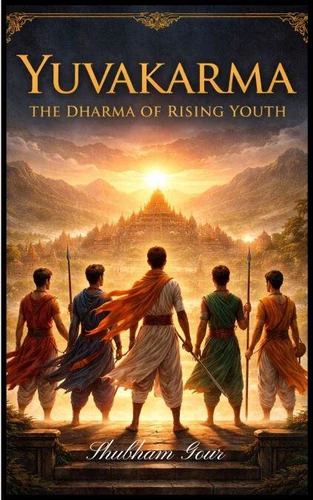
"Yuvakarma: The Dharma of Rising Youth" is a philosophical fiction set in the ancient symbolic kingdom of Vairagya Nagar, within the wider world of Aryavarta. The story explores the journey of youth as a powerful phase of inner construction, where awareness, discipline, and choices silently shape the foundation of future destiny. The narrative follows five young individuals-Aryan, Yuvendra, Sankalpveer Agnivrat, Dharmev Shoryan, and Anandbodh Vicharyan-who gradually transform from ordinary youth into conscious architects of change.
While the kingdom around them falls into distraction, imbalance, and eventual collapse, these five cultivate structure, discipline, strength, balance, and awareness within themselves. As instability spreads across Vairagya Nagar, the five rise not through sudden power, but through years of silent preparation and inner refinement. Their journey becomes the turning point for the kingdom's restoration, guiding society back toward clarity, order, and understanding.
At its core, the fiction conveys a deeper message: youth is not merely a passing stage of life, but the most crucial period for building one's character, direction, and consciousness. Time does not create destiny on its own-it only reveals what has already been shaped through awareness and action. Blending symbolism with philosophical reflection, this story invites readers to see life not as random experience, but as a continuous process of conscious construction.
"Yuvakarma: The Dharma of Rising Youth" is a philosophical fiction set in the ancient symbolic kingdom of Vairagya Nagar, within the wider world of Aryavarta. The story explores the journey of youth as a powerful phase of inner construction, where awareness, discipline, and choices silently shape the foundation of future destiny. The narrative follows five young individuals-Aryan, Yuvendra, Sankalpveer Agnivrat, Dharmev Shoryan, and Anandbodh Vicharyan-who gradually transform from ordinary youth into conscious architects of change.
While the kingdom around them falls into distraction, imbalance, and eventual collapse, these five cultivate structure, discipline, strength, balance, and awareness within themselves. As instability spreads across Vairagya Nagar, the five rise not through sudden power, but through years of silent preparation and inner refinement. Their journey becomes the turning point for the kingdom's restoration, guiding society back toward clarity, order, and understanding.
At its core, the fiction conveys a deeper message: youth is not merely a passing stage of life, but the most crucial period for building one's character, direction, and consciousness. Time does not create destiny on its own-it only reveals what has already been shaped through awareness and action. Blending symbolism with philosophical reflection, this story invites readers to see life not as random experience, but as a continuous process of conscious construction.


 , qui est-ce ?