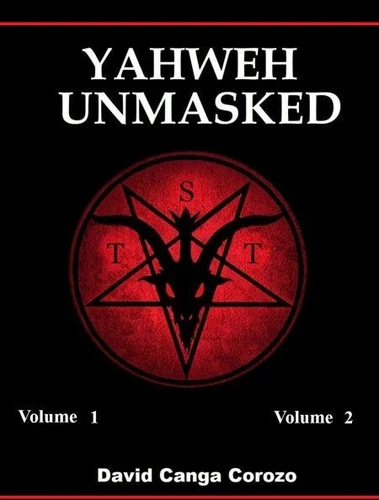
Yahweh Unmasked by David Cangá Corozo is a daring and uncompromising work that confronts one of the greatest taboos in human history: the identity and nature of the god worshiped as Yahweh. Through historical inquiry, theological critique, and scriptural analysis, the book strips away centuries of reverence to reveal a figure radically different from the merciful Father proclaimed by Jesus of Nazareth.
From the earliest civilizations, humanity has turned to divine figures to explain catastrophes, justify violence, and sanctify triumphs. Religion has inspired art, law, and philosophy, but it has also sanctioned inquisitions, crusades, and persecution. The book argues that the persistence of evil cannot be explained by doctrines like "original sin, " but lies in human nature itself, with religion serving as a channel for control and fear.
Within this framework, the work examines the Bible's depiction of Yahweh. The god who emerges from scripture is not a universal creator of love, but a tribal warlord obsessed with loyalty, blood sacrifices, and revenge. He rewards killing, punishes mercy, commands genocides, and deceives his followers. These traits are contrasted with the teachings of Jesus, who preached love, forgiveness, and compassion, pointing instead to the Father-an entirely different God.
The book also explores how doctrine was shaped by councils, theologians, and political powers to mask contradictions and preserve authority. It shows how reinterpretations of law and salvation transformed Jesus' original message into something that often reinforced the very oppression he opposed. Across history, dissenting voices such as Marcion, the Gnostics, and the Cathars denounced the cruelty of Yahweh, and many paid with their lives.
The central thesis is clear: the Father invoked by Jesus cannot be reconciled with the wrathful Yahweh of Israel. They embody opposing doctrines-one based on vengeance and law, the other on love and freedom. The conclusion is stark: Yahweh is not the Father of Jesus but his adversary, the deceiver masked for millennia as God. Yahweh Unmasked is more than a critique of theology; it is a call to intellectual courage.
It invites readers to set aside inherited certainties and confront the possibility that the foundations of Judeo-Christian belief rest on deception. It presents scripture and history with raw clarity, forcing readers to decide whether Yahweh deserves devotion-or whether he should finally be unmasked. Written in direct and uncompromising prose, the book appeals to skeptics, historians, and seekers who have questioned the morality of the Old Testament or struggled with contradictions between Yahweh and Jesus.
It suggests that authentic divinity, if it exists, must be sought not in fear, vengeance, or deception, but in compassion, justice, and truth-the values humanity has always yearned for, even when religion betrayed them. Bold, controversial, and necessary, Yahweh Unmasked is more than a book: it is a manifesto for freedom of thought and a milestone in the ongoing struggle to understand God and the human condition.
Yahweh Unmasked by David Cangá Corozo is a daring and uncompromising work that confronts one of the greatest taboos in human history: the identity and nature of the god worshiped as Yahweh. Through historical inquiry, theological critique, and scriptural analysis, the book strips away centuries of reverence to reveal a figure radically different from the merciful Father proclaimed by Jesus of Nazareth.
From the earliest civilizations, humanity has turned to divine figures to explain catastrophes, justify violence, and sanctify triumphs. Religion has inspired art, law, and philosophy, but it has also sanctioned inquisitions, crusades, and persecution. The book argues that the persistence of evil cannot be explained by doctrines like "original sin, " but lies in human nature itself, with religion serving as a channel for control and fear.
Within this framework, the work examines the Bible's depiction of Yahweh. The god who emerges from scripture is not a universal creator of love, but a tribal warlord obsessed with loyalty, blood sacrifices, and revenge. He rewards killing, punishes mercy, commands genocides, and deceives his followers. These traits are contrasted with the teachings of Jesus, who preached love, forgiveness, and compassion, pointing instead to the Father-an entirely different God.
The book also explores how doctrine was shaped by councils, theologians, and political powers to mask contradictions and preserve authority. It shows how reinterpretations of law and salvation transformed Jesus' original message into something that often reinforced the very oppression he opposed. Across history, dissenting voices such as Marcion, the Gnostics, and the Cathars denounced the cruelty of Yahweh, and many paid with their lives.
The central thesis is clear: the Father invoked by Jesus cannot be reconciled with the wrathful Yahweh of Israel. They embody opposing doctrines-one based on vengeance and law, the other on love and freedom. The conclusion is stark: Yahweh is not the Father of Jesus but his adversary, the deceiver masked for millennia as God. Yahweh Unmasked is more than a critique of theology; it is a call to intellectual courage.
It invites readers to set aside inherited certainties and confront the possibility that the foundations of Judeo-Christian belief rest on deception. It presents scripture and history with raw clarity, forcing readers to decide whether Yahweh deserves devotion-or whether he should finally be unmasked. Written in direct and uncompromising prose, the book appeals to skeptics, historians, and seekers who have questioned the morality of the Old Testament or struggled with contradictions between Yahweh and Jesus.
It suggests that authentic divinity, if it exists, must be sought not in fear, vengeance, or deception, but in compassion, justice, and truth-the values humanity has always yearned for, even when religion betrayed them. Bold, controversial, and necessary, Yahweh Unmasked is more than a book: it is a manifesto for freedom of thought and a milestone in the ongoing struggle to understand God and the human condition.