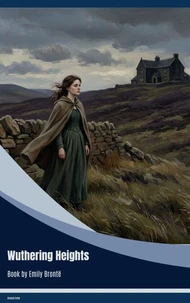
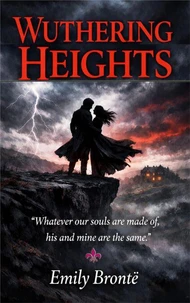
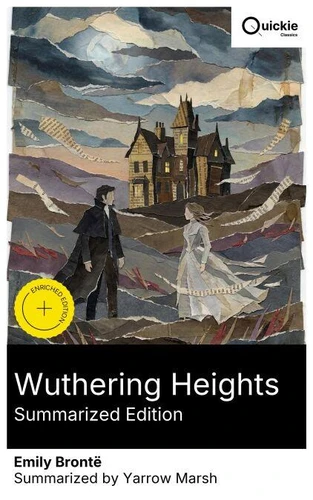
Wuthering Heights (1847) fuses Gothic ferocity with Romantic sublimity in a daring frame-tale. Through Lockwood's and Nelly Dean's layered testimonies, Brontë charts the interdependence of Catherine Earnshaw and Heathcliff across two generations at Wuthering Heights and Thrushcross Grange. Temporal loops, unreliable narrators, and vernacular textures entwine grief, revenge, and property, while the Yorkshire moors-elemental, indifferent-shape fate.
Its audacious design and metaphysical intensity challenged Victorian realism, redefining the domestic Gothic of passion, class antagonism, and inheritance. Emily Brontë, the reclusive daughter of the Haworth parsonage, honed a fierce lyric sensibility in juvenilia and poetry before publishing as "Ellis Bell." The isolation of the Pennine moors, family losses, and her self-education yielded an imagination at once inward and elemental.
Living amid stringent class and gender codes, she forged a vision that interrogates power, kinship, and possession. Essential for students of Victorian fiction and all readers of psychological Gothic, this novel rewards rereading: its polyphonic testimony unsettles judgment, and its storm-lit cadences linger. Come for the love story; stay for a radical meditation on selfhood, family, property, and place.
Quickie Classics summarizes timeless works with precision, preserving the author's voice and keeping the prose clear, fast, and readable-distilled, never diluted.
Enriched Edition extras: Introduction · Synopsis · Historical Context · Author Biography · Brief Analysis · 4 Reflection Q&As · Editorial Footnotes.
Wuthering Heights (1847) fuses Gothic ferocity with Romantic sublimity in a daring frame-tale. Through Lockwood's and Nelly Dean's layered testimonies, Brontë charts the interdependence of Catherine Earnshaw and Heathcliff across two generations at Wuthering Heights and Thrushcross Grange. Temporal loops, unreliable narrators, and vernacular textures entwine grief, revenge, and property, while the Yorkshire moors-elemental, indifferent-shape fate.
Its audacious design and metaphysical intensity challenged Victorian realism, redefining the domestic Gothic of passion, class antagonism, and inheritance. Emily Brontë, the reclusive daughter of the Haworth parsonage, honed a fierce lyric sensibility in juvenilia and poetry before publishing as "Ellis Bell." The isolation of the Pennine moors, family losses, and her self-education yielded an imagination at once inward and elemental.
Living amid stringent class and gender codes, she forged a vision that interrogates power, kinship, and possession. Essential for students of Victorian fiction and all readers of psychological Gothic, this novel rewards rereading: its polyphonic testimony unsettles judgment, and its storm-lit cadences linger. Come for the love story; stay for a radical meditation on selfhood, family, property, and place.
Quickie Classics summarizes timeless works with precision, preserving the author's voice and keeping the prose clear, fast, and readable-distilled, never diluted.
Enriched Edition extras: Introduction · Synopsis · Historical Context · Author Biography · Brief Analysis · 4 Reflection Q&As · Editorial Footnotes.

 , qui est-ce ?