
DM Ole Kiminta is a Canadian of Maasai heritage. He spent many years working in USA, Britain and in Canada. He is an Industrial engineer, Petroleum engineer and Chemical engineer. Ole Kiminta was educated in USA and United Kingdom. Some of his published research work include Material science, carbon fibres and other composite materials, Polymeric materials, and Particle technology. He currently works for the Canadian government and lives in Toronto Canada with his family.
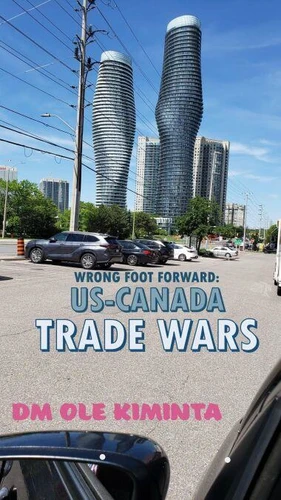
Wrong foot forward: US-Canada trade wars
Par :Formats :
Disponible dans votre compte client Decitre ou Furet du Nord dès validation de votre commande. Le format ePub est :
- Compatible avec une lecture sur My Vivlio (smartphone, tablette, ordinateur)
- Compatible avec une lecture sur liseuses Vivlio
- Pour les liseuses autres que Vivlio, vous devez utiliser le logiciel Adobe Digital Edition. Non compatible avec la lecture sur les liseuses Kindle, Remarkable et Sony
 , qui est-ce ?
Notre partenaire de plateforme de lecture numérique où vous retrouverez l'ensemble de vos ebooks gratuitement
Pour en savoir plus sur nos ebooks, consultez notre aide en ligne ici
C'est si simple ! Lisez votre ebook avec l'app Vivlio sur votre tablette, mobile ou ordinateur :

- FormatePub
- ISBN8230289951
- EAN9798230289951
- Date de parution15/01/2025
- Protection num.pas de protection
- Infos supplémentairesepub
- ÉditeurIndependently Published
Résumé
The consequences of illegal border crossings and the flow of illicit drugs and weapons extend far beyond the immediate law enforcement challenges they present. Local economies, particularly those in border regions, face significant repercussions that can hinder growth and stability. When trade tensions escalate, as has been seen in recent years, local businesses often bear the brunt of these conflicts.
The imposition of tariffs and trade barriers can lead to reduced access to markets, increased costs for consumers, and a general decline in economic activity within these communities. The consequences of illegal border crossings and the illicit flow of drugs and weapons cannot justify trade wars between the USA and Canada. The economic ramifications are far-reaching and detrimental to the very communities that such policies aim to protect.
Policymakers must recognise the interconnectedness of local economies and work toward solutions that prioritise legitimate trade, community development, and cross-border cooperation rather than punitive measures that only serve to deepen economic divides. A focus on collaboration, rather than confrontation, will ultimately foster healthier economic environments and enhance the resilience of border communities.
The imposition of tariffs and trade barriers can lead to reduced access to markets, increased costs for consumers, and a general decline in economic activity within these communities. The consequences of illegal border crossings and the illicit flow of drugs and weapons cannot justify trade wars between the USA and Canada. The economic ramifications are far-reaching and detrimental to the very communities that such policies aim to protect.
Policymakers must recognise the interconnectedness of local economies and work toward solutions that prioritise legitimate trade, community development, and cross-border cooperation rather than punitive measures that only serve to deepen economic divides. A focus on collaboration, rather than confrontation, will ultimately foster healthier economic environments and enhance the resilience of border communities.
A propos de DM Ole Kiminta

5,99 €

6,99 €

8,49 €

The last blue planet
E-book
5,99 €

7,99 €
5,99 €

5,99 €
4,99 €


Tethered to the Kitchen
E-book
5,99 €
4,49 €

Aim to live for 200
E-book
5,99 €

Live to be 200
E-book
9,99 €
6,99 €

6,49 €

Dissuading war mongers
E-book
6,49 €

6,99 €

9,49 €