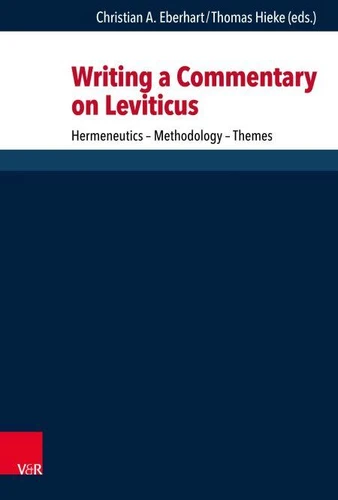
Writing a Commentary on Leviticus. Hermeneutics – Methodology – Themes
Par : , ,Formats :
Disponible dans votre compte client Decitre ou Furet du Nord dès validation de votre commande. Le format PDF est :
- Compatible avec une lecture sur My Vivlio (smartphone, tablette, ordinateur)
- Compatible avec une lecture sur liseuses Vivlio
- Pour les liseuses autres que Vivlio, vous devez utiliser le logiciel Adobe Digital Edition. Non compatible avec la lecture sur les liseuses Kindle, Remarkable et Sony
 , qui est-ce ?
Notre partenaire de plateforme de lecture numérique où vous retrouverez l'ensemble de vos ebooks gratuitement
Pour en savoir plus sur nos ebooks, consultez notre aide en ligne ici
C'est si simple ! Lisez votre ebook avec l'app Vivlio sur votre tablette, mobile ou ordinateur :

- Nombre de pages270
- FormatPDF
- ISBN978-3-647-53471-8
- EAN9783647534718
- Date de parution15/04/2019
- Protection num.pas de protection
- Taille6 Mo
- Infos supplémentairespdf
- ÉditeurVandenhoeck & Ruprecht
Résumé
Writing a commentary on a biblical book is not limited to the scholar's study and desk. Hence, several experts in the field of Hebrew Bible currently writing a larger commentary on the book of Leviticus followed the invitation of Christian Eberhart and Thomas Hieke to meet between 2014 and 2016 at the Annual SBL Conference. They shared their experiences, discussed hermeneutical and methodological considerations, and presented their ideas about particular themes and issues in the third book of the Torah.
The results of these consultative panels had significant impact on the production of the commentaries. The first part of this volume features essays reflecting on the process of writing a Leviticus commentary, including boosts and obstacles, while suggesting innovative insights on particular problems of the book. The second part identifies certain themes of Leviticus, especially sacrifices and rituals ("the cult"), the notion of unintentional and deliberate sins and purity/impurity ("the bad") and how to eliminate them, and the relationship to the sphere of God ("the holy").
This section demonstrates how commenting a biblical book highly depends on the perspective a scholar takes, and how different commentaries on the same biblical text come to different conclusions because of a diversity of methodological and hermeneutical approaches. These are issues innate in the subject matter; in the end the variety of approaches bears witness to the complexity, intricacy, and richness of the biblical text.
This volume, therefore, offers a fascinating inside view into the studies and onto the desks of several prolific biblical experts who share their reflections and concepts about their commentaries on Leviticus with an interested audience.
The results of these consultative panels had significant impact on the production of the commentaries. The first part of this volume features essays reflecting on the process of writing a Leviticus commentary, including boosts and obstacles, while suggesting innovative insights on particular problems of the book. The second part identifies certain themes of Leviticus, especially sacrifices and rituals ("the cult"), the notion of unintentional and deliberate sins and purity/impurity ("the bad") and how to eliminate them, and the relationship to the sphere of God ("the holy").
This section demonstrates how commenting a biblical book highly depends on the perspective a scholar takes, and how different commentaries on the same biblical text come to different conclusions because of a diversity of methodological and hermeneutical approaches. These are issues innate in the subject matter; in the end the variety of approaches bears witness to the complexity, intricacy, and richness of the biblical text.
This volume, therefore, offers a fascinating inside view into the studies and onto the desks of several prolific biblical experts who share their reflections and concepts about their commentaries on Leviticus with an interested audience.
A propos de Thomas Hieke
12,99 €
41,99 €
41,99 €