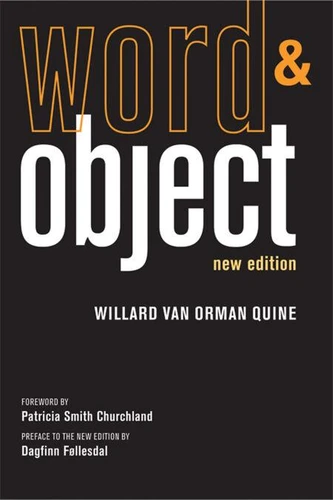
A new edition of Quine's most important work. Willard Van Orman Quine begins this influential work by declaring, "Language is a social art. In acquiring it we have to depend entirely on intersubjectively available cues as to what to say and when." As Patricia Smith Churchland notes in her foreword to this new edition, with Word and Object Quine challenged the tradition of conceptual analysis as a way of advancing knowledge.
The book signaled twentieth-century philosophy's turn away from metaphysics and what Churchland calls the "phony precision" of conceptual analysis. In the course of his discussion of meaning and the linguistic mechanisms of objective reference, Quine considers the indeterminacy of translation, brings to light the anomalies and conflicts implicit in our language's referential apparatus, clarifies semantic problems connected with the imputation of existence, and marshals reasons for admitting or repudiating each of various categories of supposed objects.
In addition to Churchland's foreword, this edition offers a new preface by Quine's student and colleague Dagfinn Follesdal that describes the never-realized plans for a second edition of Word and Object, in which Quine would offer a more unified treatment of the public nature of meaning, modalities, and propositional attitudes.
A new edition of Quine's most important work. Willard Van Orman Quine begins this influential work by declaring, "Language is a social art. In acquiring it we have to depend entirely on intersubjectively available cues as to what to say and when." As Patricia Smith Churchland notes in her foreword to this new edition, with Word and Object Quine challenged the tradition of conceptual analysis as a way of advancing knowledge.
The book signaled twentieth-century philosophy's turn away from metaphysics and what Churchland calls the "phony precision" of conceptual analysis. In the course of his discussion of meaning and the linguistic mechanisms of objective reference, Quine considers the indeterminacy of translation, brings to light the anomalies and conflicts implicit in our language's referential apparatus, clarifies semantic problems connected with the imputation of existence, and marshals reasons for admitting or repudiating each of various categories of supposed objects.
In addition to Churchland's foreword, this edition offers a new preface by Quine's student and colleague Dagfinn Follesdal that describes the never-realized plans for a second edition of Word and Object, in which Quine would offer a more unified treatment of the public nature of meaning, modalities, and propositional attitudes.

 , qui est-ce ?
