SOLDES
Jusqu'à -70% sur une sélection d'articles*

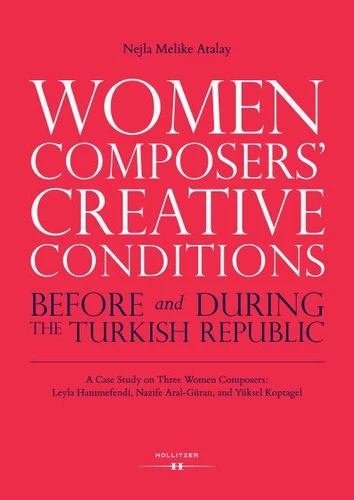
Women Composers' Creative Conditions Before and During the Turkish Republic. A Case Study on Three Women Composers: Leyla Hanımefendi, Nazife Aral-Güran, and Yüksel Koptagel
Par :Formats :
Disponible dans votre compte client Decitre ou Furet du Nord dès validation de votre commande. Le format PDF est :
- Compatible avec une lecture sur My Vivlio (smartphone, tablette, ordinateur)
- Compatible avec une lecture sur liseuses Vivlio
- Pour les liseuses autres que Vivlio, vous devez utiliser le logiciel Adobe Digital Edition. Non compatible avec la lecture sur les liseuses Kindle, Remarkable et Sony
 , qui est-ce ?
Notre partenaire de plateforme de lecture numérique où vous retrouverez l'ensemble de vos ebooks gratuitement
Pour en savoir plus sur nos ebooks, consultez notre aide en ligne ici
C'est si simple ! Lisez votre ebook avec l'app Vivlio sur votre tablette, mobile ou ordinateur :

- Nombre de pages516
- FormatPDF
- ISBN978-3-99012-851-0
- EAN9783990128510
- Date de parution14/10/2021
- Protection num.Digital Watermarking
- Taille88 Mo
- Infos supplémentairespdf
- ÉditeurHollitzer Wissenschaftsverlag
Résumé
This research is focused on three Istanbulite composers, Leyla Hanimefendi, Nazife Aral-Güran, and Yüksel Koptagel, who lived and produced in consecutive and overlapping periods, from the Tanzimat Era of the Ottoman Empire to the Turkish Republic of the 1980s. It explores the composers' productive and creative conditions through the socio-political environments of their times, their familial and educational backgrounds, and the social spaces in which they lived and worked.
The institutionalisation of Western music and the education thereof occupy a significant place in understanding the composers' relationships with Western music, the bonds they established with polyphonic music, and the development of their musical personalities as a consequence of their education, resultant from the opportunities provided by such developments. This study conjointly examines herstory and music historiography by employing alternative materials and creating its own narrative.
The institutionalisation of Western music and the education thereof occupy a significant place in understanding the composers' relationships with Western music, the bonds they established with polyphonic music, and the development of their musical personalities as a consequence of their education, resultant from the opportunities provided by such developments. This study conjointly examines herstory and music historiography by employing alternative materials and creating its own narrative.