Sam Whitfield moved to Wren Hollow three days ago, and she still can't find the box with the crib sheets. New town. New baby. A husband who worries about her more than he says out loud, and worries harder every time she brings up the things she can't quite explain. Sam didn't come to Wren Hollow to make friends fast. She came here to survive the next year of her daughter's life one nap schedule at a time, one long, silent 3 a.m.
at a time, in a subdivision so relentlessly optimistic it feels, some days, like a stage set for somebody else's happy ending. Then her daughter starts having a dream. Not an ordinary bad dream. The same dream, night after night, growing more detailed each time: a field at the edge of town, a circle of women standing in it, a house burning down while nobody moves to stop it. Sam tells herself there's a reasonable explanation.
New mothers have anxious imaginations. Toddlers absorb strange fragments of the world around them and hand them back distorted. She almost manages to believe it. Then, at pickup one ordinary afternoon, she mentions the dream to another mother, carefully, testing the words out loud for the first time. And the other woman goes very still, because her own son has been describing the exact same field, the exact same circle, the exact same fire, for weeks.
What unfolds from there is a slow, unnerving unraveling of everything Sam thought she understood about her new neighborhood. The women at her yoga studio who seem to know each other a little too well. The quiet, composed elder everyone in town respects but nobody actually knows. A PTA committee that suddenly feels like it's circling something none of its members will name out loud. One by one, the women of Wren Hollow start finding each other, drawn together by their children's shared visions and a history none of them have been told, while Sam watches from the outside, a newcomer trying to read a language everyone else seems to already half-know.
Sam came to this town wanting, more than anything, to belong somewhere. She is starting to understand that belonging here might mean something far stranger, and far heavier, than she ever bargained for, and that the ground underneath this picture-perfect suburb has been quietly shifting for thirty years, long before her moving truck ever pulled onto Aster Court. This is not a horror story. The danger, when it finally shows itself, is emotional before it is anything else: the vertigo of realizing the people around you have been carrying something you were never told, the ache of wanting connection badly enough to keep reaching for it even when your instincts say to be careful.
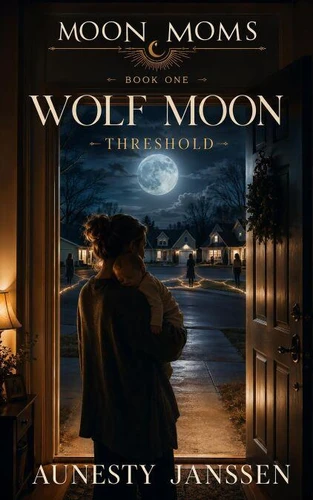
Wolf Moon is cozy in the way a porch light is cozy on a cold night: warm, welcoming, and only slightly unsettling once you notice what might be standing just outside its reach. Wren Hollow itself becomes its own kind of character here, a town built entirely out of second chances, every house a slightly different roofline over the exact same optimistic beige, the kind of place designed to look like nothing bad could ever happen inside its borders.
Sam watches it from the outside for most of the book, an outsider cataloguing a world she doesn't yet have the language for. Wolf Moon: Threshold is Book One of the Moon Moms series, a cozy, character-driven story about isolation, motherhood, and the particular kind of magic that comes from discovering you were never as alone as you felt. Told through Sam's eyes, it's the reader's way into a suburb where tarot decks live in kitchen drawers, moon rituals happen in backyards, and the past has a way of reaching for the people who least expect it.
If you love found family, slow-burn supernatural mystery, and stories about the specific loneliness and wonder of early motherhood, Wolf Moon is your way in. The series continues in Book Two: Snow Moon, Coincidence.
Sam Whitfield moved to Wren Hollow three days ago, and she still can't find the box with the crib sheets. New town. New baby. A husband who worries about her more than he says out loud, and worries harder every time she brings up the things she can't quite explain. Sam didn't come to Wren Hollow to make friends fast. She came here to survive the next year of her daughter's life one nap schedule at a time, one long, silent 3 a.m.
at a time, in a subdivision so relentlessly optimistic it feels, some days, like a stage set for somebody else's happy ending. Then her daughter starts having a dream. Not an ordinary bad dream. The same dream, night after night, growing more detailed each time: a field at the edge of town, a circle of women standing in it, a house burning down while nobody moves to stop it. Sam tells herself there's a reasonable explanation.
New mothers have anxious imaginations. Toddlers absorb strange fragments of the world around them and hand them back distorted. She almost manages to believe it. Then, at pickup one ordinary afternoon, she mentions the dream to another mother, carefully, testing the words out loud for the first time. And the other woman goes very still, because her own son has been describing the exact same field, the exact same circle, the exact same fire, for weeks.
What unfolds from there is a slow, unnerving unraveling of everything Sam thought she understood about her new neighborhood. The women at her yoga studio who seem to know each other a little too well. The quiet, composed elder everyone in town respects but nobody actually knows. A PTA committee that suddenly feels like it's circling something none of its members will name out loud. One by one, the women of Wren Hollow start finding each other, drawn together by their children's shared visions and a history none of them have been told, while Sam watches from the outside, a newcomer trying to read a language everyone else seems to already half-know.
Sam came to this town wanting, more than anything, to belong somewhere. She is starting to understand that belonging here might mean something far stranger, and far heavier, than she ever bargained for, and that the ground underneath this picture-perfect suburb has been quietly shifting for thirty years, long before her moving truck ever pulled onto Aster Court. This is not a horror story. The danger, when it finally shows itself, is emotional before it is anything else: the vertigo of realizing the people around you have been carrying something you were never told, the ache of wanting connection badly enough to keep reaching for it even when your instincts say to be careful.
Wolf Moon is cozy in the way a porch light is cozy on a cold night: warm, welcoming, and only slightly unsettling once you notice what might be standing just outside its reach. Wren Hollow itself becomes its own kind of character here, a town built entirely out of second chances, every house a slightly different roofline over the exact same optimistic beige, the kind of place designed to look like nothing bad could ever happen inside its borders.
Sam watches it from the outside for most of the book, an outsider cataloguing a world she doesn't yet have the language for. Wolf Moon: Threshold is Book One of the Moon Moms series, a cozy, character-driven story about isolation, motherhood, and the particular kind of magic that comes from discovering you were never as alone as you felt. Told through Sam's eyes, it's the reader's way into a suburb where tarot decks live in kitchen drawers, moon rituals happen in backyards, and the past has a way of reaching for the people who least expect it.
If you love found family, slow-burn supernatural mystery, and stories about the specific loneliness and wonder of early motherhood, Wolf Moon is your way in. The series continues in Book Two: Snow Moon, Coincidence.

 , qui est-ce ?