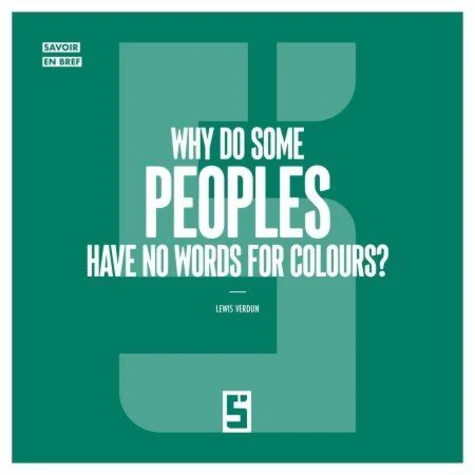
Part of the SAVOIR EN BREF collection (Publisher : Five Minutes), this short book explores a fascinating linguistic mystery : why do some cultures lack words for certain colours ? Drawing on rigorous research published in 2024 and 2025, it shows that the absence of colour terms does not imply an absence of perception. The book presents the universal hierarchy of colour emergence, identifies languages that use no colour words (Pirahã, Mursi, Warlpiri...), and examines field studies on the Tsimane' of the Amazon and the Himba of Namibia.
It explains how history, environment and the scarcity of pigments delayed the emergence of certain words - blue being a prime example - and how language contact and bilingualism can transform the lexicon, as seen among the Tsimane' and Lithuanian-Norwegian bilinguals. Chapters on cognition reveal that learning colour words is a lengthy process and that category boundaries vary across languages. This book ultimately demonstrates that linguistic diversity reflects different attentional strategies rather than perceptual deficits.
It invites readers to broaden their understanding of language and to discover how words shape our view of the world. An essential read for anyone interested in language, culture and cognition.
Part of the SAVOIR EN BREF collection (Publisher : Five Minutes), this short book explores a fascinating linguistic mystery : why do some cultures lack words for certain colours ? Drawing on rigorous research published in 2024 and 2025, it shows that the absence of colour terms does not imply an absence of perception. The book presents the universal hierarchy of colour emergence, identifies languages that use no colour words (Pirahã, Mursi, Warlpiri...), and examines field studies on the Tsimane' of the Amazon and the Himba of Namibia.
It explains how history, environment and the scarcity of pigments delayed the emergence of certain words - blue being a prime example - and how language contact and bilingualism can transform the lexicon, as seen among the Tsimane' and Lithuanian-Norwegian bilinguals. Chapters on cognition reveal that learning colour words is a lengthy process and that category boundaries vary across languages. This book ultimately demonstrates that linguistic diversity reflects different attentional strategies rather than perceptual deficits.
It invites readers to broaden their understanding of language and to discover how words shape our view of the world. An essential read for anyone interested in language, culture and cognition.