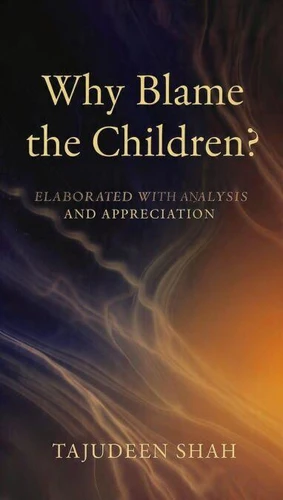
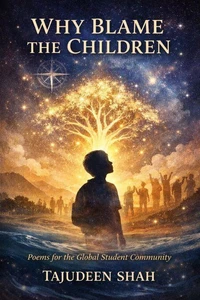
THE REVOLUTIONARY PREMISE: SHIFTING THE PARADIGM OF GENERATIONAL GUILTIn an era defined by hyper-acceleration, digital fragmentation, and what can only be termed as "Super-Chaos, " the modern world faces an unspoken crisis: the systemic pathologizing of its youth. Every day, global headlines, academic journals, and social commentaries lament the rising tide of anxiety, detachment, and indifference among children and teenagers.
Yet, society rarely stops to ask the fundamental question that lies at the heart of this poetic manifesto: Why Blame the Children?This monumental anthology by visionary poet and philosopher Tajudeen Shah is not merely a collection of verse; it is a disruptive, emotionally charged literary intervention. It serves as a profound psychological and somatic shield designed to protect vulnerable youth while shifting the burden of modern anxiety entirely away from the shoulders of the young and onto the erratic, restless, and hyper-industrialized systems constructed by adults.
Born from a profound ten-year period of creative silence, lived history, and deep human empathy, these verses provide an unyielding critique of a world that has sacrificed the sanctuary of home to a lifestyle that is dangerously restless and chaotic. The core thesis of this anthology is simple yet revolutionary: the indifference, anxiety, and defensive shells we witness in today's children are not signs of a generational defect.
Instead, they are direct, logical reflections of an environment they did not build. They are the casualties of toxic air, fractured nature, and relentless institutional pressures. When a child looks upon the modern landscape with detached eyes, they are not failing society; society has failed to provide them with the quiet, pure harvest of olden days. By reading this anthology, audiences are invited to step out of the cycle of blame and into an expansive, restorative space of deep understanding, ultimate wisdom, and collective healing.
A NEW MONUMENT IN WORLD AND ENGLISH LITERATURETo understand the artistic weight of Why Blame the Children?, one must position it within the grand tapestry of world literature in general, and the rich legacy of English literature in particular. For centuries, literature has attempted to capture the essence of childhood innocence and its collision with experience. We see remnants of this sacred struggle in the visionary romanticism of William Wordsworth and Samuel Taylor Coleridge, who viewed the child as a natural prophet possessing an innate connection to the divine.
Elsewhere, the spiritual humanism of Rabindranath Tagore illuminated the intercultural chords that connect individual human souls to the universal collective. Tajudeen Shah's anthology stands as a direct, contemporary heir to this immortal lineage, but with a unique structural and technological evolution. It speaks to a global consciousness-the Human hive. Recognizing that the fractures of the modern world affect all of humanity, the anthology synthesizes Western literary forms with Eastern philosophical depths.
It creates a universal vocabulary of empathy that resonates equally across continents, cultures, and socio-economic divides, weaving a tapestry of shared human destiny. Step onto the soft sod. Join the debate. Believe in the future.
THE REVOLUTIONARY PREMISE: SHIFTING THE PARADIGM OF GENERATIONAL GUILTIn an era defined by hyper-acceleration, digital fragmentation, and what can only be termed as "Super-Chaos, " the modern world faces an unspoken crisis: the systemic pathologizing of its youth. Every day, global headlines, academic journals, and social commentaries lament the rising tide of anxiety, detachment, and indifference among children and teenagers.
Yet, society rarely stops to ask the fundamental question that lies at the heart of this poetic manifesto: Why Blame the Children?This monumental anthology by visionary poet and philosopher Tajudeen Shah is not merely a collection of verse; it is a disruptive, emotionally charged literary intervention. It serves as a profound psychological and somatic shield designed to protect vulnerable youth while shifting the burden of modern anxiety entirely away from the shoulders of the young and onto the erratic, restless, and hyper-industrialized systems constructed by adults.
Born from a profound ten-year period of creative silence, lived history, and deep human empathy, these verses provide an unyielding critique of a world that has sacrificed the sanctuary of home to a lifestyle that is dangerously restless and chaotic. The core thesis of this anthology is simple yet revolutionary: the indifference, anxiety, and defensive shells we witness in today's children are not signs of a generational defect.
Instead, they are direct, logical reflections of an environment they did not build. They are the casualties of toxic air, fractured nature, and relentless institutional pressures. When a child looks upon the modern landscape with detached eyes, they are not failing society; society has failed to provide them with the quiet, pure harvest of olden days. By reading this anthology, audiences are invited to step out of the cycle of blame and into an expansive, restorative space of deep understanding, ultimate wisdom, and collective healing.
A NEW MONUMENT IN WORLD AND ENGLISH LITERATURETo understand the artistic weight of Why Blame the Children?, one must position it within the grand tapestry of world literature in general, and the rich legacy of English literature in particular. For centuries, literature has attempted to capture the essence of childhood innocence and its collision with experience. We see remnants of this sacred struggle in the visionary romanticism of William Wordsworth and Samuel Taylor Coleridge, who viewed the child as a natural prophet possessing an innate connection to the divine.
Elsewhere, the spiritual humanism of Rabindranath Tagore illuminated the intercultural chords that connect individual human souls to the universal collective. Tajudeen Shah's anthology stands as a direct, contemporary heir to this immortal lineage, but with a unique structural and technological evolution. It speaks to a global consciousness-the Human hive. Recognizing that the fractures of the modern world affect all of humanity, the anthology synthesizes Western literary forms with Eastern philosophical depths.
It creates a universal vocabulary of empathy that resonates equally across continents, cultures, and socio-economic divides, weaving a tapestry of shared human destiny. Step onto the soft sod. Join the debate. Believe in the future.