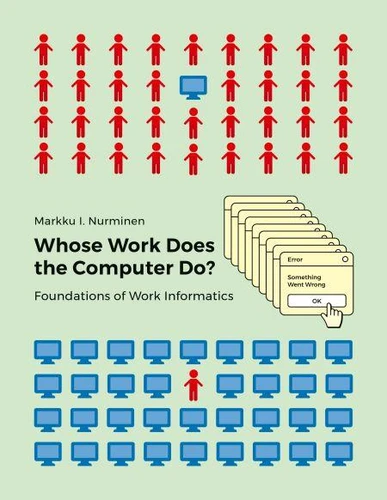
Whose Work Does the Computer Do?. Foundations of Work Informatics
Par :Formats :
Disponible dans votre compte client Decitre ou Furet du Nord dès validation de votre commande. Le format ePub est :
- Compatible avec une lecture sur My Vivlio (smartphone, tablette, ordinateur)
- Compatible avec une lecture sur liseuses Vivlio
- Pour les liseuses autres que Vivlio, vous devez utiliser le logiciel Adobe Digital Edition. Non compatible avec la lecture sur les liseuses Kindle, Remarkable et Sony
 , qui est-ce ?
Notre partenaire de plateforme de lecture numérique où vous retrouverez l'ensemble de vos ebooks gratuitement
Pour en savoir plus sur nos ebooks, consultez notre aide en ligne ici
C'est si simple ! Lisez votre ebook avec l'app Vivlio sur votre tablette, mobile ou ordinateur :

- Nombre de pages324
- FormatePub
- ISBN978-952-89-8680-5
- EAN9789528986805
- Date de parution19/02/2026
- Protection num.Digital Watermarking
- Taille4 Mo
- Infos supplémentairesepub
- ÉditeurBoD - Books on Demand
Résumé
In this book, which belongs to the field of Information Systems Research, work informatics refers extensively to information technology and information systems. Its point of departure, however, is work itself, while technology must settle for playing the role of being a tool. The goal of an information system thus lies outside itself - in the goal-oriented activities of an organization. In work informatics, work takes on three faces: individual work, collaboration, and services.
For its part, information technology combines to serve all of these. The case studies provided by the Laboris research group underline the descriptive and explanatory power of work informatics. The collection of Laboris accounts takes its structure from a selected set of theoretical and conceptual frameworks, most of them drawn from the human sciences. Work informatics sheds new light on agility, a goal pursued by many organizations.
It also helps actual knowledge workers - individuals and groups - to grasp the silent and invisible questions of internal working life, which, given their nature, often seem to escape even the slightest touch.
For its part, information technology combines to serve all of these. The case studies provided by the Laboris research group underline the descriptive and explanatory power of work informatics. The collection of Laboris accounts takes its structure from a selected set of theoretical and conceptual frameworks, most of them drawn from the human sciences. Work informatics sheds new light on agility, a goal pursued by many organizations.
It also helps actual knowledge workers - individuals and groups - to grasp the silent and invisible questions of internal working life, which, given their nature, often seem to escape even the slightest touch.