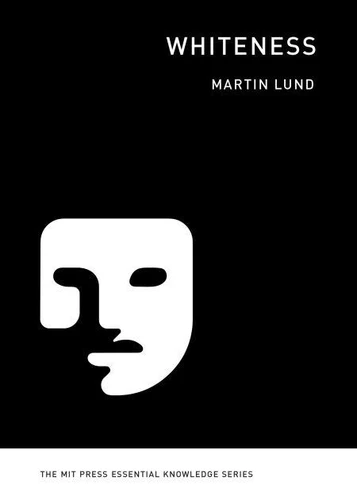
Whiteness
Par :Formats :
Disponible dans votre compte client Decitre ou Furet du Nord dès validation de votre commande. Le format ePub protégé est :
- Compatible avec une lecture sur My Vivlio (smartphone, tablette, ordinateur)
- Compatible avec une lecture sur liseuses Vivlio
- Pour les liseuses autres que Vivlio, vous devez utiliser le logiciel Adobe Digital Edition. Non compatible avec la lecture sur les liseuses Kindle, Remarkable et Sony
- Non compatible avec un achat hors France métropolitaine
 , qui est-ce ?
Notre partenaire de plateforme de lecture numérique où vous retrouverez l'ensemble de vos ebooks gratuitement
Pour en savoir plus sur nos ebooks, consultez notre aide en ligne ici
C'est si simple ! Lisez votre ebook avec l'app Vivlio sur votre tablette, mobile ou ordinateur :

- Nombre de pages272
- FormatePub
- ISBN978-0-262-37079-0
- EAN9780262370790
- Date de parution04/10/2022
- Protection num.Adobe DRM
- Taille629 Ko
- Infos supplémentairesepub
- ÉditeurThe MIT Press
Résumé
The socially constructed phenomenon of whiteness: how it was created, how it changes, and how it protects and privileges people who are perceived as white. This volume in the MIT Press Essential Knowledge series examines the socially constructed phenomenon of whiteness, tracing its creation, its changing formation, and its power to privilege and protect people who are perceived as white. Whiteness, author Martin Lund explains, is not one single idea but a shifting, overarching category, a flexible cluster of historically, culturally, and geographically contingent ideals and standards that enable systems of hierarchical classification.
Lund discusses words used to talk about whiteness, from white privilege to white fragility; the intersections of whiteness with race, class, and gender; whiteness in popular culture; and such ideas as "colorblindness" and "reverse racism, " which, he argues, actually uphold whiteness. Lund shows why it is important to keep talking and thinking about whiteness. The word "whiteness, " he writes, doesn't describe; it conjures something into being.
Drawing on decades of critical whiteness studies and citing a range of examples (primarily from the United States and Sweden), Lund argues that whiteness is continually manufactured and sustained through language, laws, policies, science, and representations in media and popular culture. It is often positioned as normative, even universal. And despite its innocuous-seeming manifestations in sitcoms and superheroes, whiteness is always in the service of racial domination.
Lund discusses words used to talk about whiteness, from white privilege to white fragility; the intersections of whiteness with race, class, and gender; whiteness in popular culture; and such ideas as "colorblindness" and "reverse racism, " which, he argues, actually uphold whiteness. Lund shows why it is important to keep talking and thinking about whiteness. The word "whiteness, " he writes, doesn't describe; it conjures something into being.
Drawing on decades of critical whiteness studies and citing a range of examples (primarily from the United States and Sweden), Lund argues that whiteness is continually manufactured and sustained through language, laws, policies, science, and representations in media and popular culture. It is often positioned as normative, even universal. And despite its innocuous-seeming manifestations in sitcoms and superheroes, whiteness is always in the service of racial domination.