Isabelle Collins is an English-language nonfiction author known for writing elegant and deeply reflective books on culture, identity, and emotional resilience. Her work blends literary storytelling with thoughtful social observation, exploring how memory, relationships, and personal reinvention shape the human experience across different stages of life. Isabelle's writing style is graceful and immersive, turning subtle emotional landscapes into narratives that feel intimate, intelligent, and quietly luminous.
Nouveauté
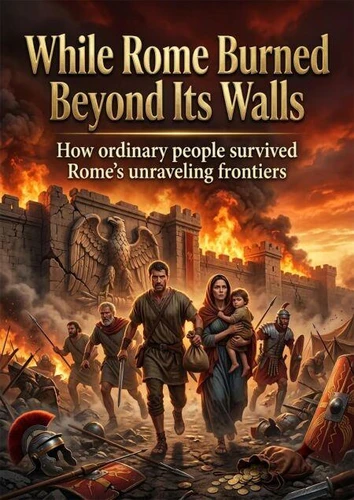
While Rome Burned Beyond Its Walls. How ordinary people survived Rome's unraveling frontiers
Par :Formats :
Disponible dans votre compte client Decitre ou Furet du Nord dès validation de votre commande. Le format ePub est :
- Compatible avec une lecture sur My Vivlio (smartphone, tablette, ordinateur)
- Compatible avec une lecture sur liseuses Vivlio
- Pour les liseuses autres que Vivlio, vous devez utiliser le logiciel Adobe Digital Edition. Non compatible avec la lecture sur les liseuses Kindle, Remarkable et Sony
 , qui est-ce ?
Notre partenaire de plateforme de lecture numérique où vous retrouverez l'ensemble de vos ebooks gratuitement
Pour en savoir plus sur nos ebooks, consultez notre aide en ligne ici
C'est si simple ! Lisez votre ebook avec l'app Vivlio sur votre tablette, mobile ou ordinateur :

- Nombre de pages142
- FormatePub
- ISBN978-3-565-58968-5
- EAN9783565589685
- Date de parution26/07/2026
- Protection num.pas de protection
- Taille1 Mo
- Infos supplémentairesepub
- ÉditeurEmphaloz Publishing House
Résumé
The frontier was never a line on a map. It was a living space where Roman soldiers, local farmers, and migrating peoples met, traded, and clashed. This book reconstructs the final centuries of the Western Roman Empire from the perspective of its borderlands-the provinces of Gaul, Britannia, and the Danube basin-where imperial control was always thin and eventually vanished. Using archaeological evidence from abandoned forts, hoarded coinage, and shifting settlement patterns, it tracks how ordinary people adapted to a world where the state could no longer protect them.
Local strongmen filled the power gap. Villages fortified themselves. Trade routes became warpaths. The book argues that the Empire did not fall all at once but dissolved region by region, as the center lost the ability to project force and the periphery learned to survive without it. For readers curious about the human dimension of civilizational collapse, this is a ground-level view of history's most famous dissolution.
Local strongmen filled the power gap. Villages fortified themselves. Trade routes became warpaths. The book argues that the Empire did not fall all at once but dissolved region by region, as the center lost the ability to project force and the periphery learned to survive without it. For readers curious about the human dimension of civilizational collapse, this is a ground-level view of history's most famous dissolution.