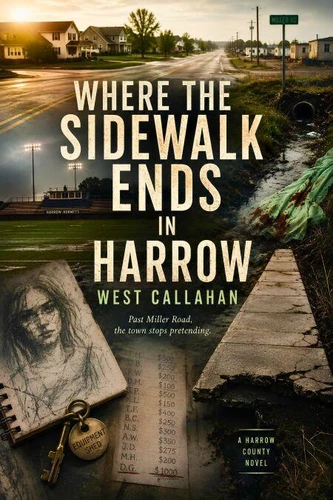
Prom night. A drainage ditch behind the high school football field. A sixteen-year-old girl in a fourteen-dollar dress, bleeding and silent in the dark. When Josie Falk is found unconscious after the Harrow High prom, the town builds its story fast: the mayor's quarterback son must be responsible. It's the kind of narrative a place like Harrow, Ohio, knows how to tell - rich boy, poor girl, one bad night.
Simple. Containable. Done. But Dean Sorrento, the school principal hired from Toledo two years ago, doesn't buy it. Not when security camera footage vanishes from a locked server closet overnight. Not when the vice principal calls in sick for the first time in four years after a 6:45 a.m. phone call from the school board chair. Not when every person in a position of authority tells him, politely and firmly, to stop asking questions.
Josie isn't talking. Not to the police. Not to her father. But from her hospital bed, she draws. Faces rendered in pencil with unsparing precision. A floor plan of a shed nobody was supposed to enter. A list of names and dollar amounts she copied from a document she found hidden behind traffic cones - a document with her thirteen-year-old brother's name on it. The list leads Dean past the convenient Brett Connolly story and into something far worse: a years-long scheme using west-side boys as undocumented labor, funded through the Booster Club, supervised by the athletic director, and protected by every institution in town - from the school board to the sheriff's department to the mayor's office.
A scheme that has been poisoning the groundwater of the families whose children it exploits. In Harrow, Miller Road divides the town in two. On the east side, the sidewalk runs clean and continuous all the way to school. On the west side, it stops mid-block, as if the town ran out of money or interest or the will to pretend that the people past that point deserved a path. Josie Falk noticed where the sidewalk ended.
She's the only one who did. Told in alternating voices - Dean's measured, grief-haunted investigation and Josie's raw, first-person fragments from the hospital - Where the Sidewalk Ends in Harrow is a novel about the machinery of small-town silence: who it protects, who it grinds, and what happens when a girl with a sketchbook and a principal with nothing left to lose decide that the truth matters more than the town's comfort.
Prom night. A drainage ditch behind the high school football field. A sixteen-year-old girl in a fourteen-dollar dress, bleeding and silent in the dark. When Josie Falk is found unconscious after the Harrow High prom, the town builds its story fast: the mayor's quarterback son must be responsible. It's the kind of narrative a place like Harrow, Ohio, knows how to tell - rich boy, poor girl, one bad night.
Simple. Containable. Done. But Dean Sorrento, the school principal hired from Toledo two years ago, doesn't buy it. Not when security camera footage vanishes from a locked server closet overnight. Not when the vice principal calls in sick for the first time in four years after a 6:45 a.m. phone call from the school board chair. Not when every person in a position of authority tells him, politely and firmly, to stop asking questions.
Josie isn't talking. Not to the police. Not to her father. But from her hospital bed, she draws. Faces rendered in pencil with unsparing precision. A floor plan of a shed nobody was supposed to enter. A list of names and dollar amounts she copied from a document she found hidden behind traffic cones - a document with her thirteen-year-old brother's name on it. The list leads Dean past the convenient Brett Connolly story and into something far worse: a years-long scheme using west-side boys as undocumented labor, funded through the Booster Club, supervised by the athletic director, and protected by every institution in town - from the school board to the sheriff's department to the mayor's office.
A scheme that has been poisoning the groundwater of the families whose children it exploits. In Harrow, Miller Road divides the town in two. On the east side, the sidewalk runs clean and continuous all the way to school. On the west side, it stops mid-block, as if the town ran out of money or interest or the will to pretend that the people past that point deserved a path. Josie Falk noticed where the sidewalk ended.
She's the only one who did. Told in alternating voices - Dean's measured, grief-haunted investigation and Josie's raw, first-person fragments from the hospital - Where the Sidewalk Ends in Harrow is a novel about the machinery of small-town silence: who it protects, who it grinds, and what happens when a girl with a sketchbook and a principal with nothing left to lose decide that the truth matters more than the town's comfort.


 , qui est-ce ?