
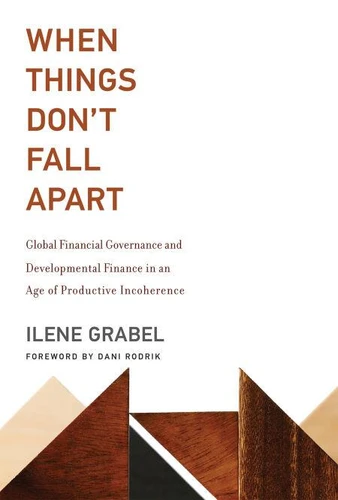
When Things Don't Fall Apart. Global Financial Governance and Developmental Finance in an Age of Productive Incoherence
Par : ,Formats :
Disponible dans votre compte client Decitre ou Furet du Nord dès validation de votre commande. Le format ePub protégé est :
- Compatible avec une lecture sur My Vivlio (smartphone, tablette, ordinateur)
- Compatible avec une lecture sur liseuses Vivlio
- Pour les liseuses autres que Vivlio, vous devez utiliser le logiciel Adobe Digital Edition. Non compatible avec la lecture sur les liseuses Kindle, Remarkable et Sony
- Non compatible avec un achat hors France métropolitaine
 , qui est-ce ?
Notre partenaire de plateforme de lecture numérique où vous retrouverez l'ensemble de vos ebooks gratuitement
Pour en savoir plus sur nos ebooks, consultez notre aide en ligne ici
C'est si simple ! Lisez votre ebook avec l'app Vivlio sur votre tablette, mobile ou ordinateur :

- Nombre de pages400
- FormatePub
- ISBN978-0-262-34405-0
- EAN9780262344050
- Date de parution12/01/2018
- Protection num.Adobe DRM
- Taille2 Mo
- Infos supplémentairesepub
- ÉditeurThe MIT Press
Résumé
An account of the significant though gradual, uneven, disconnected, ad hoc, and pragmatic innovations in global financial governance and developmental finance induced by the global financial crisis. In When Things Don't Fall Apart, Ilene Grabel challenges the dominant view that the global financial crisis had little effect on global financial governance and developmental finance. Most observers discount all but grand, systemic ruptures in institutions and policy.
Grabel argues instead that the global crisis induced inconsistent and ad hoc discontinuities in global financial governance and developmental finance that are now having profound effects on emerging market and developing economies. Grabel's chief normative claim is that the resulting incoherence in global financial governance is productive rather than debilitating. In the age of productive incoherence, a more complex, dense, fragmented, and pluripolar form of global financial governance is expanding possibilities for policy and institutional experimentation, policy space for economic and human development, financial stability and resilience, and financial inclusion.
Grabel draws on key theoretical commitments of Albert Hirschman to cement the case for the productivity of incoherence. Inspired by Hirschman, Grabel demonstrates that meaningful change often emerges from disconnected, erratic, experimental, and inconsistent adjustments in institutions and policies as actors pragmatically manage in an evolving world. Grabel substantiates her claims with empirically rich case studies that explore the effects of recent crises on networks of financial governance (such as the G-20); transformations within the IMF; institutional innovations in liquidity support and project finance from the national to the transregional levels; and the "rebranding" of capital controls.
Grabel concludes with a careful examination of the opportunities and risks associated with the evolutionary transformations underway.
Grabel argues instead that the global crisis induced inconsistent and ad hoc discontinuities in global financial governance and developmental finance that are now having profound effects on emerging market and developing economies. Grabel's chief normative claim is that the resulting incoherence in global financial governance is productive rather than debilitating. In the age of productive incoherence, a more complex, dense, fragmented, and pluripolar form of global financial governance is expanding possibilities for policy and institutional experimentation, policy space for economic and human development, financial stability and resilience, and financial inclusion.
Grabel draws on key theoretical commitments of Albert Hirschman to cement the case for the productivity of incoherence. Inspired by Hirschman, Grabel demonstrates that meaningful change often emerges from disconnected, erratic, experimental, and inconsistent adjustments in institutions and policies as actors pragmatically manage in an evolving world. Grabel substantiates her claims with empirically rich case studies that explore the effects of recent crises on networks of financial governance (such as the G-20); transformations within the IMF; institutional innovations in liquidity support and project finance from the national to the transregional levels; and the "rebranding" of capital controls.
Grabel concludes with a careful examination of the opportunities and risks associated with the evolutionary transformations underway.