SOLDES
Jusqu'à -70% sur une sélection d'articles*

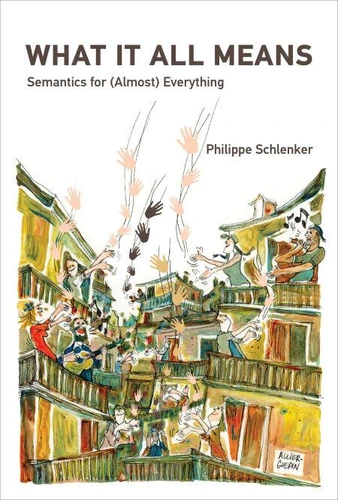
What It All Means. Semantics for (Almost) Everything
Par :Formats :
Disponible dans votre compte client Decitre ou Furet du Nord dès validation de votre commande. Le format Epub fixed layout protégé est :
- Compatible avec une lecture sur My Vivlio (smartphone, tablette, ordinateur)
- Compatible avec une lecture sur liseuses Vivlio
- Pour les liseuses autres que Vivlio, vous devez utiliser le logiciel Adobe Digital Edition. Non compatible avec la lecture sur les liseuses Kindle, Remarkable et Sony
- Non compatible avec un achat hors France métropolitaine
 , qui est-ce ?
Notre partenaire de plateforme de lecture numérique où vous retrouverez l'ensemble de vos ebooks gratuitement
Pour en savoir plus sur nos ebooks, consultez notre aide en ligne ici
C'est si simple ! Lisez votre ebook avec l'app Vivlio sur votre tablette, mobile ou ordinateur :

- Nombre de pages520
- FormatEpub fixed layout
- ISBN978-0-262-37177-3
- EAN9780262371773
- Date de parution22/11/2022
- Protection num.Adobe DRM
- Taille50 Mo
- Infos supplémentairesepub
- ÉditeurThe MIT Press
Résumé
How meaning works-from monkey calls to human language, from spoken language to sign language, from gestures to music-and how meaning is connected to truth. We communicate through language, connecting what we mean to the words we say. But humans convey meaning in other ways as well, with facial expressions, hand gestures, and other methods. Animals, too, can get their meanings across without words.
In What It All Means, linguist Philippe Schlenker explains how meaning works, from monkey calls to human language, from spoken language to sign language, from gestures to music. He shows that these extraordinarily diverse types of meaning can be studied and compared within a unified approach-one in which the notion of truth plays a central role. "It's just semantics" is often said dismissively. But Schlenker shows that semantics-the study of meaning-is an unsung success of modern linguistics, a way to investigate some of the deepest questions about human nature using tools from the empirical and formal sciences.
Drawing on fifty years of research in formal semantics, Schlenker traces how meaning comes to life. After investigating meaning in primate communication, he explores how human meanings are built, using in some cases sign languages as a guide to the workings of our inner "logic machine." Schlenker explores how these meanings can be enriched by iconicity in sign language and by gestures in spoken language, and then turns to more abstract forms of iconicity to understand the meaning of music.
He concludes by examining paradoxes, which-being neither true nor false-test the very limits of meaning.
In What It All Means, linguist Philippe Schlenker explains how meaning works, from monkey calls to human language, from spoken language to sign language, from gestures to music. He shows that these extraordinarily diverse types of meaning can be studied and compared within a unified approach-one in which the notion of truth plays a central role. "It's just semantics" is often said dismissively. But Schlenker shows that semantics-the study of meaning-is an unsung success of modern linguistics, a way to investigate some of the deepest questions about human nature using tools from the empirical and formal sciences.
Drawing on fifty years of research in formal semantics, Schlenker traces how meaning comes to life. After investigating meaning in primate communication, he explores how human meanings are built, using in some cases sign languages as a guide to the workings of our inner "logic machine." Schlenker explores how these meanings can be enriched by iconicity in sign language and by gestures in spoken language, and then turns to more abstract forms of iconicity to understand the meaning of music.
He concludes by examining paradoxes, which-being neither true nor false-test the very limits of meaning.