
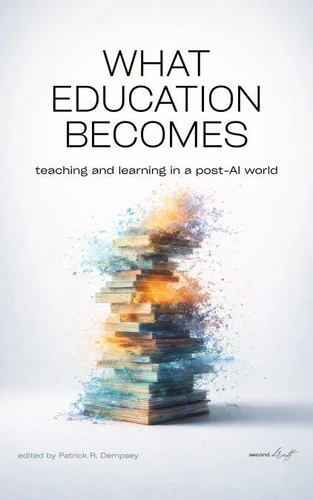
What Education Becomes
Par :Formats :
Disponible dans votre compte client Decitre ou Furet du Nord dès validation de votre commande. Le format ePub est :
- Compatible avec une lecture sur My Vivlio (smartphone, tablette, ordinateur)
- Compatible avec une lecture sur liseuses Vivlio
- Pour les liseuses autres que Vivlio, vous devez utiliser le logiciel Adobe Digital Edition. Non compatible avec la lecture sur les liseuses Kindle, Remarkable et Sony
 , qui est-ce ?
Notre partenaire de plateforme de lecture numérique où vous retrouverez l'ensemble de vos ebooks gratuitement
Pour en savoir plus sur nos ebooks, consultez notre aide en ligne ici
C'est si simple ! Lisez votre ebook avec l'app Vivlio sur votre tablette, mobile ou ordinateur :

- FormatePub
- ISBN8994784402
- EAN9798994784402
- Date de parution17/02/2026
- Protection num.pas de protection
- Infos supplémentairesepub
- ÉditeurGroupe Business Thérapie
Résumé
When AI becomes infrastructure rather than novelty, what does education actually become? This collection features 12 educators and researchers examining teaching and learning in a post-AI world. Through three sections-Reconceptualizing Foundations, Necessary Resistance, and Proof of Concept-contributors explore both AI's transformative potential and essential human elements that must be preserved.
What distinguishes this work is its refusal to resolve tensions: it honors both the promise of personalized learning at scale and the irreplaceable value of productive struggle and human presence. Readers find frameworks for curriculum design when content becomes commodity, warnings about over-optimization destroying purpose, examination of psychological risks in extended AI interaction, and working models from composition classrooms, graduate seminars, and civic learning systems. This serves individual educators seeking practical approaches, administrators designing institutional responses, and policymakers ready to move beyond "how do we handle AI?" toward "what does education become when AI just is?" The diverse voices and deliberately disparate styles create a discussion-in-process rather than a definitive roadmap-exactly what this moment of transformation requires.
What distinguishes this work is its refusal to resolve tensions: it honors both the promise of personalized learning at scale and the irreplaceable value of productive struggle and human presence. Readers find frameworks for curriculum design when content becomes commodity, warnings about over-optimization destroying purpose, examination of psychological risks in extended AI interaction, and working models from composition classrooms, graduate seminars, and civic learning systems. This serves individual educators seeking practical approaches, administrators designing institutional responses, and policymakers ready to move beyond "how do we handle AI?" toward "what does education become when AI just is?" The diverse voices and deliberately disparate styles create a discussion-in-process rather than a definitive roadmap-exactly what this moment of transformation requires.