SOLDES
Jusqu'à -70% sur une sélection d'articles*

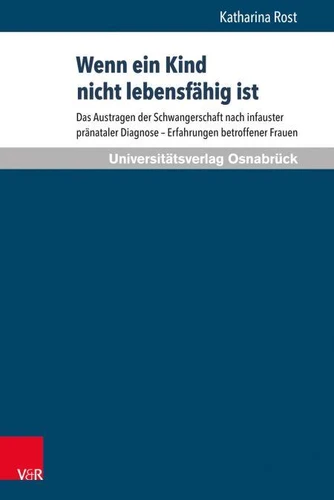
Wenn ein Kind nicht lebensfähig ist. Das Austragen der Schwangerschaft nach infauster pränataler Diagnose – Erfahrungen betroffener Frauen
Par :Formats :
Disponible dans votre compte client Decitre ou Furet du Nord dès validation de votre commande. Le format PDF est :
- Compatible avec une lecture sur My Vivlio (smartphone, tablette, ordinateur)
- Compatible avec une lecture sur liseuses Vivlio
- Pour les liseuses autres que Vivlio, vous devez utiliser le logiciel Adobe Digital Edition. Non compatible avec la lecture sur les liseuses Kindle, Remarkable et Sony
 , qui est-ce ?
Notre partenaire de plateforme de lecture numérique où vous retrouverez l'ensemble de vos ebooks gratuitement
Pour en savoir plus sur nos ebooks, consultez notre aide en ligne ici
C'est si simple ! Lisez votre ebook avec l'app Vivlio sur votre tablette, mobile ou ordinateur :

- Nombre de pages383
- FormatPDF
- ISBN978-3-8470-0373-1
- EAN9783847003731
- Date de parution16/09/2015
- Protection num.pas de protection
- Taille3 Mo
- Infos supplémentairespdf
- ÉditeurV&R Unipress
Résumé
When women are confronted with the prenatal diagnosis of a fetal abnormality, they have to decide whether to terminate or continue that pregnancy. Studies show that most women decide to terminate the pregnancy . While studies exist in Germany about women continuing pregnancies after the diagnosis of a viable fetal impairment such as Down-Syndrom, little is known about women who decide to continue pregnancy after the prenatal diagnosis of a lethal condition.
This study examines the experiences of women, who continue their pregnancy after the diagnosis of "inviability of the child". Furthermore this study aims to develop recommendations in order to improve the support and care provided by health professionals. The main result of the research is that women experience the diagnosis as a severe biographical disruption during the state of pregnancy, which requires a complex process of re-adjustment.
The diagnosis and the resulting decision-making has to be understood as a dynamic part within this process of reorientation, not as the endpoint of this process.
This study examines the experiences of women, who continue their pregnancy after the diagnosis of "inviability of the child". Furthermore this study aims to develop recommendations in order to improve the support and care provided by health professionals. The main result of the research is that women experience the diagnosis as a severe biographical disruption during the state of pregnancy, which requires a complex process of re-adjustment.
The diagnosis and the resulting decision-making has to be understood as a dynamic part within this process of reorientation, not as the endpoint of this process.