
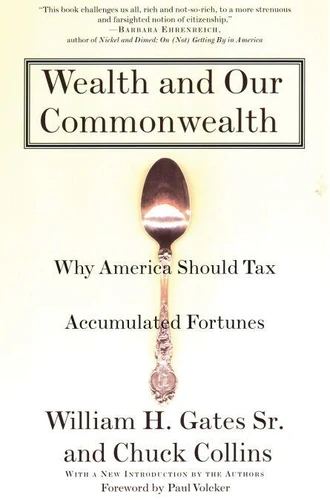
Wealth and Our Commonwealth. Why America Should Tax Accumulated Fortunes
Par : ,Formats :
Disponible dans votre compte client Decitre ou Furet du Nord dès validation de votre commande. Le format ePub protégé est :
- Compatible avec une lecture sur My Vivlio (smartphone, tablette, ordinateur)
- Compatible avec une lecture sur liseuses Vivlio
- Pour les liseuses autres que Vivlio, vous devez utiliser le logiciel Adobe Digital Edition. Non compatible avec la lecture sur les liseuses Kindle, Remarkable et Sony
- Non compatible avec un achat hors France métropolitaine
 , qui est-ce ?
Notre partenaire de plateforme de lecture numérique où vous retrouverez l'ensemble de vos ebooks gratuitement
Pour en savoir plus sur nos ebooks, consultez notre aide en ligne ici
C'est si simple ! Lisez votre ebook avec l'app Vivlio sur votre tablette, mobile ou ordinateur :

- Nombre de pages184
- FormatePub
- ISBN978-0-8070-9588-1
- EAN9780807095881
- Date de parution16/02/2016
- Protection num.Adobe DRM
- Taille450 Ko
- Infos supplémentairesepub
- ÉditeurBeacon Press
Résumé
The 'Man Bites Dog' story of over 1, 000 high net-worth individuals who rose up to protest the repeal of the estate tax made headlines everywhere last year. Central to the organization of what Newsweek tagged the 'billionaire backlash' were two visionaries: Bill Gates, Sr., cochair of the Bill and Melinda Gates Foundation, the largest foundation on earth, and Chuck Collins, cofounder of United for a Fair Economy and Responsible Wealth, and the great-grandson of meat packer Oscar Mayer who gave away his substantial inheritance at the age of twenty-six.
Gates and Collins argue that individual wealth is a product not only of hard work and smart choices but of the society that provides the fertile soil for success. They don't subscribe to the 'Great Man' theory of wealth creation but contend that society's investments, such as economic development, education, health care, and property rights protection, all contribute to any individual's good fortune.
With the repeal proposed by the Bush administration, we might be facing the future that Teddy Roosevelt feared-where huge fortunes amassed and untaxed would evolve into a dangerous and permanent aristocracy. Repeal would drop federal revenues $294 billion in the first 10 years; 27 some $750 billion would be lost in the second decade, not to mention that the U. S. Treasury estimates that charitable contributions would drop by $6 billion a year.
But what about all those modest families that would lose the farm? Gates and Collins expose the fallacy of this argument, pointing out that this is largely a myth and that the very same lobbies and politicians who are crying 'cows' have opposed other legislation that would actually have helped small farmers. Weaving in personal narratives, history, and plenty of solid economic sense, Gates and Collins make a sound and compelling case for tax reform, not repeal.
Gates and Collins argue that individual wealth is a product not only of hard work and smart choices but of the society that provides the fertile soil for success. They don't subscribe to the 'Great Man' theory of wealth creation but contend that society's investments, such as economic development, education, health care, and property rights protection, all contribute to any individual's good fortune.
With the repeal proposed by the Bush administration, we might be facing the future that Teddy Roosevelt feared-where huge fortunes amassed and untaxed would evolve into a dangerous and permanent aristocracy. Repeal would drop federal revenues $294 billion in the first 10 years; 27 some $750 billion would be lost in the second decade, not to mention that the U. S. Treasury estimates that charitable contributions would drop by $6 billion a year.
But what about all those modest families that would lose the farm? Gates and Collins expose the fallacy of this argument, pointing out that this is largely a myth and that the very same lobbies and politicians who are crying 'cows' have opposed other legislation that would actually have helped small farmers. Weaving in personal narratives, history, and plenty of solid economic sense, Gates and Collins make a sound and compelling case for tax reform, not repeal.