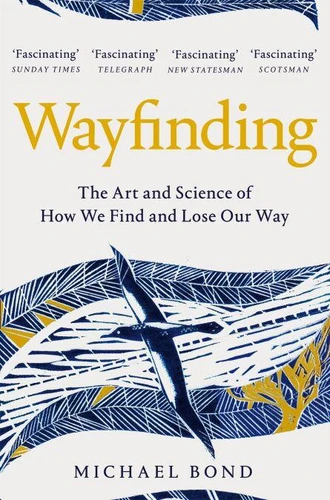
'Beautifully written and researched.' - Isabella Tree, author of WildingThe physical world is infinitely complex, yet most of us are able to find our way around it. We can walk through unfamiliar streets while maintaining a sense of direction, take shortcuts along paths we have never used and remember for many years places we have visited only once. These are remarkable achievements. In Wayfinding, Michael Bond explores how we do it: how our brains make the 'cognitive maps' that keep us orientated, even in places that we don't know.
He considers how we relate to places, and asks how our understanding of the world around us affects our psychology and behaviour. The way we think about physical space has been crucial to our evolution: the ability to navigate over large distances in prehistoric times gave Homo sapiens an advantage over the rest of the human family. Children are instinctive explorers, developing a spatial understanding as they roam.
And yet today few of us make use of the wayfaring skills that we inherited from our nomadic ancestors. Most of us have little idea what we may be losing. Bond seeks an answer to the question of why some of us are so much better at finding our way than others. He also tackles the controversial subject of sex differences in navigation, and finally tries to understand why being lost can be such a devastating psychological experience.
For readers of writers as different as Robert Macfarlane and Oliver Sacks, Wayfinding is a book that can change our sense of ourselves.'A fascinating excursion into the very nature of exploration. Absorbing stuff.' - explorer Benedict Allen
'Beautifully written and researched.' - Isabella Tree, author of WildingThe physical world is infinitely complex, yet most of us are able to find our way around it. We can walk through unfamiliar streets while maintaining a sense of direction, take shortcuts along paths we have never used and remember for many years places we have visited only once. These are remarkable achievements. In Wayfinding, Michael Bond explores how we do it: how our brains make the 'cognitive maps' that keep us orientated, even in places that we don't know.
He considers how we relate to places, and asks how our understanding of the world around us affects our psychology and behaviour. The way we think about physical space has been crucial to our evolution: the ability to navigate over large distances in prehistoric times gave Homo sapiens an advantage over the rest of the human family. Children are instinctive explorers, developing a spatial understanding as they roam.
And yet today few of us make use of the wayfaring skills that we inherited from our nomadic ancestors. Most of us have little idea what we may be losing. Bond seeks an answer to the question of why some of us are so much better at finding our way than others. He also tackles the controversial subject of sex differences in navigation, and finally tries to understand why being lost can be such a devastating psychological experience.
For readers of writers as different as Robert Macfarlane and Oliver Sacks, Wayfinding is a book that can change our sense of ourselves.'A fascinating excursion into the very nature of exploration. Absorbing stuff.' - explorer Benedict Allen


 , qui est-ce ?