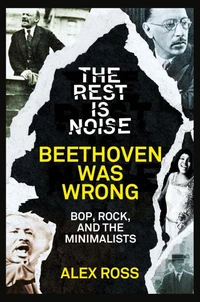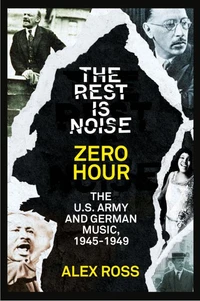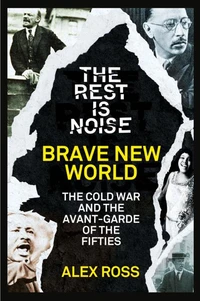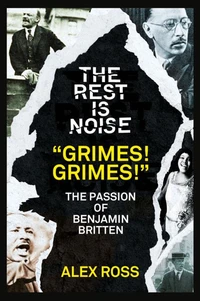
Alex Ross graduated from Harvard in 1990. He wrote for the New York Times from 1992 until 1996 when he became staff writer at the New Yorker. His first book The Rest is Noise is about the cultural history of music since 1990, which won the Guardian First Book Award. It was also shortlisted for the Samuel Johnson non-fiction prize and the Pulitzer Prize. He is also the author of Listen to This. He lives in Los Angeles.
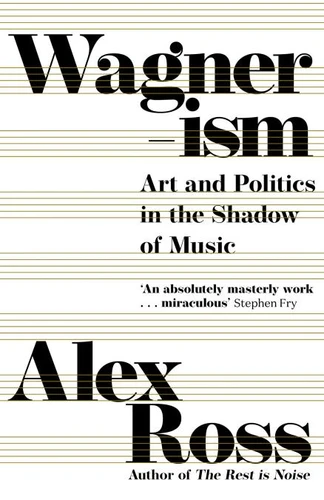
Wagnerism. Art and Politics in the Shadow of Music
Par :Formats :
Disponible dans votre compte client Decitre ou Furet du Nord dès validation de votre commande. Le format ePub protégé est :
- Compatible avec une lecture sur My Vivlio (smartphone, tablette, ordinateur)
- Compatible avec une lecture sur liseuses Vivlio
- Pour les liseuses autres que Vivlio, vous devez utiliser le logiciel Adobe Digital Edition. Non compatible avec la lecture sur les liseuses Kindle, Remarkable et Sony
- Non compatible avec un achat hors France métropolitaine
 , qui est-ce ?
Notre partenaire de plateforme de lecture numérique où vous retrouverez l'ensemble de vos ebooks gratuitement
Pour en savoir plus sur nos ebooks, consultez notre aide en ligne ici
C'est si simple ! Lisez votre ebook avec l'app Vivlio sur votre tablette, mobile ou ordinateur :

- Nombre de pages784
- FormatePub
- ISBN978-0-00-751851-7
- EAN9780007518517
- Date de parution15/09/2020
- Protection num.Adobe DRM
- Infos supplémentairesepub
- ÉditeurFourth Estate
Résumé
'An absolutely masterly work' Stephen Fry
Alex Ross, renowned author of the international bestseller The Rest Is Noise, reveals how Richard Wagner became the proving ground for modern art and politics-an aesthetic war zone where the Western world wrestled with its capacity for beauty and violence.
For better or worse, Wagner is the most widely influential figure in the history of music. Around 1900, the phenomenon known as Wagnerism saturated European and American culture.
Such colossal creations as The Ring of the Nibelung, Tristan und Isolde, and Parsifal were models of formal daring, mythmaking, erotic freedom, and mystical speculation. A mighty procession of writers, artists, and thinkers, including Charles Baudelaire, Virginia Woolf, Isadora Duncan, Vasily Kandinsky, and Luis Buñuel, felt his impact. Anarchists, occultists, feminists, and gay-rights pioneers saw him as a kindred spirit.
Then Adolf Hitler incorporated Wagner into the soundtrack of Nazi Germany, and the composer came to be defined by his ferocious anti-Semitism. His name is now almost synonymous with artistic evil. Wagnerism restores the magnificent confusion of what it means to be a Wagnerian. A pandemonium of geniuses, madmen, charlatans, and prophets do battle over Wagner's many-sided legacy. The narrative ranges across artistic disciplines, from architecture to the novels of Philip K.
Dick, from the Zionist writings of Theodor Herzl to the civil-rights essays of W. E. B. Du Bois, from O Pioneers! to Apocalypse Now. In many ways, Wagnerism tells a tragic tale. An artist who might have rivalled Shakespeare in universal reach is implicated in an ideology of hate. Still, his shadow lingers over twenty-first century culture, his mythic motifs coursing through superhero films and fantasy fiction.
Neither apologia nor condemnation, Wagnerism is a work of intellectual passion, urging us toward a more honest idea of how art acts in the world.
Such colossal creations as The Ring of the Nibelung, Tristan und Isolde, and Parsifal were models of formal daring, mythmaking, erotic freedom, and mystical speculation. A mighty procession of writers, artists, and thinkers, including Charles Baudelaire, Virginia Woolf, Isadora Duncan, Vasily Kandinsky, and Luis Buñuel, felt his impact. Anarchists, occultists, feminists, and gay-rights pioneers saw him as a kindred spirit.
Then Adolf Hitler incorporated Wagner into the soundtrack of Nazi Germany, and the composer came to be defined by his ferocious anti-Semitism. His name is now almost synonymous with artistic evil. Wagnerism restores the magnificent confusion of what it means to be a Wagnerian. A pandemonium of geniuses, madmen, charlatans, and prophets do battle over Wagner's many-sided legacy. The narrative ranges across artistic disciplines, from architecture to the novels of Philip K.
Dick, from the Zionist writings of Theodor Herzl to the civil-rights essays of W. E. B. Du Bois, from O Pioneers! to Apocalypse Now. In many ways, Wagnerism tells a tragic tale. An artist who might have rivalled Shakespeare in universal reach is implicated in an ideology of hate. Still, his shadow lingers over twenty-first century culture, his mythic motifs coursing through superhero films and fantasy fiction.
Neither apologia nor condemnation, Wagnerism is a work of intellectual passion, urging us toward a more honest idea of how art acts in the world.
A propos de Alex Ross
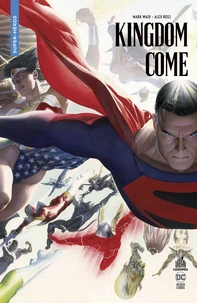
Kingdom Come
Album
5,90 €
89,00 €
15,95 €
8,96 €
15,99 €
New and Selected Stories
E-book
15,70 €
Marvel - Merveille
E-book
15,99 €
15,99 €
Justice League
Icones
Icones
E-book
14,99 €
9,99 €
9,99 €
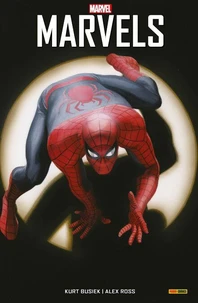
Marvels (1994)
E-book
16,99 €