
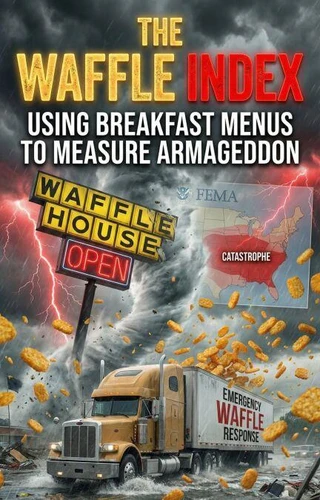
Waffle Index. Using Breakfast Menus to Measure Armageddon
Par :Formats :
Disponible dans votre compte client Decitre ou Furet du Nord dès validation de votre commande. Le format ePub est :
- Compatible avec une lecture sur My Vivlio (smartphone, tablette, ordinateur)
- Compatible avec une lecture sur liseuses Vivlio
- Pour les liseuses autres que Vivlio, vous devez utiliser le logiciel Adobe Digital Edition. Non compatible avec la lecture sur les liseuses Kindle, Remarkable et Sony
 , qui est-ce ?
Notre partenaire de plateforme de lecture numérique où vous retrouverez l'ensemble de vos ebooks gratuitement
Pour en savoir plus sur nos ebooks, consultez notre aide en ligne ici
C'est si simple ! Lisez votre ebook avec l'app Vivlio sur votre tablette, mobile ou ordinateur :

- Nombre de pages140
- FormatePub
- ISBN978-3-565-25757-7
- EAN9783565257577
- Date de parution18/02/2026
- Protection num.pas de protection
- Taille773 Ko
- Infos supplémentairesepub
- ÉditeurEmphaloz Publishing House
Résumé
When a hurricane hits the US coast, FEMA officials don't just look at weather radar; they look at Waffle House. If the local Waffle House is open and serving a full menu, things are fine (Green). If they are serving a limited menu, there is no power (Yellow). If the Waffle House is closed, it's a catastrophe (Red). This is not a joke; it is the official "Waffle House Index" used by the US government.
"The Waffle Index" explores the incredible logistics and resilience of the restaurant chain that prides itself on never closing.
It details their "jump teams" of managers who rush into disaster zones and their pre-printed "no power" menus. But the book goes deeper, using Waffle House as a lens to understand modern supply chain resilience, risk management, and the economics of disaster. It contrasts the agile, decentralized response of the private sector with the often slow bureaucracy of government relief. It is a lesson on how to stay open when the world is falling apart.
It details their "jump teams" of managers who rush into disaster zones and their pre-printed "no power" menus. But the book goes deeper, using Waffle House as a lens to understand modern supply chain resilience, risk management, and the economics of disaster. It contrasts the agile, decentralized response of the private sector with the often slow bureaucracy of government relief. It is a lesson on how to stay open when the world is falling apart.