SOLDES
Jusqu'à -70% sur une sélection d'articles*

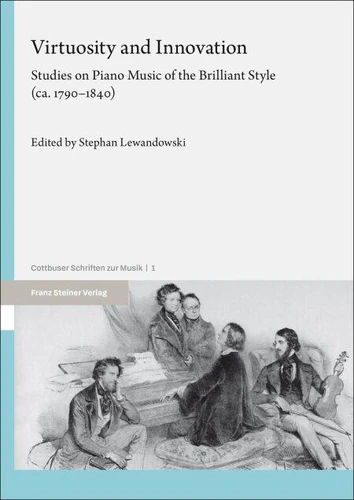
Virtuosity and Innovation. Studies on Piano Music of the Brilliant Style (ca. 1790‒1840)
Par :Formats :
Disponible dans votre compte client Decitre ou Furet du Nord dès validation de votre commande. Le format PDF est :
- Compatible avec une lecture sur My Vivlio (smartphone, tablette, ordinateur)
- Compatible avec une lecture sur liseuses Vivlio
- Pour les liseuses autres que Vivlio, vous devez utiliser le logiciel Adobe Digital Edition. Non compatible avec la lecture sur les liseuses Kindle, Remarkable et Sony
 , qui est-ce ?
Notre partenaire de plateforme de lecture numérique où vous retrouverez l'ensemble de vos ebooks gratuitement
Pour en savoir plus sur nos ebooks, consultez notre aide en ligne ici
C'est si simple ! Lisez votre ebook avec l'app Vivlio sur votre tablette, mobile ou ordinateur :

- Nombre de pages255
- FormatPDF
- ISBN978-3-515-13842-0
- EAN9783515138420
- Date de parution18/03/2025
- Protection num.Digital Watermarking
- Taille8 Mo
- Infos supplémentairespdf
- ÉditeurFranz Steiner
Résumé
This volume deals with a generation of composers that has often been overshadowed by previous music historiography: the generation between the Viennese classics and the Romantics born around 1810. To this day, piano music of the 'stile brillante' is sometimes regarded as superficially displaying virtuosity, but musically uninspired. However, the achievements of the 'pianistes compositeurs' and 'compositeurs pianistes' such as Carl Czerny (1791-1857), Friedrich Kalkbrenner (1784-1849), and Henri Herz (1803-1888) not only pertained to influencing the next generation, including such famous musicians as Fryderyk Chopin (1810-1849) and Franz Liszt (1811-1886), but also they can be measured in their very own musical efforts.
On this topic the volume provides an overview of the current state of international research in a multi-layered and wide-ranging manner. Both musicological and music-analytical contributions attempt to give a compositional ouvre, in many cases of very high quality and in some cases only recently rediscovered, a deservedly more central place in the specialist discourse.
On this topic the volume provides an overview of the current state of international research in a multi-layered and wide-ranging manner. Both musicological and music-analytical contributions attempt to give a compositional ouvre, in many cases of very high quality and in some cases only recently rediscovered, a deservedly more central place in the specialist discourse.