
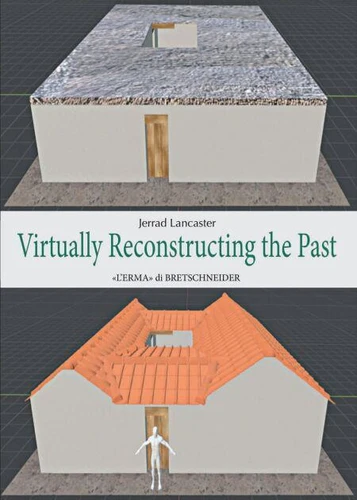
Virtually Reconstructing the Past. Estimating Labour Costs through Digital Technologies
Par :Formats :
Disponible dans votre compte client Decitre ou Furet du Nord dès validation de votre commande. Le format PDF est :
- Compatible avec une lecture sur My Vivlio (smartphone, tablette, ordinateur)
- Compatible avec une lecture sur liseuses Vivlio
- Pour les liseuses autres que Vivlio, vous devez utiliser le logiciel Adobe Digital Edition. Non compatible avec la lecture sur les liseuses Kindle, Remarkable et Sony
 , qui est-ce ?
Notre partenaire de plateforme de lecture numérique où vous retrouverez l'ensemble de vos ebooks gratuitement
Pour en savoir plus sur nos ebooks, consultez notre aide en ligne ici
C'est si simple ! Lisez votre ebook avec l'app Vivlio sur votre tablette, mobile ou ordinateur :

- Nombre de pages124
- FormatPDF
- ISBN978-88-913-2206-7
- EAN9788891322067
- Date de parution01/01/2021
- Protection num.Digital Watermarking
- Taille27 Mo
- Infos supplémentairespdf
- ÉditeurL'Erma
Résumé
Any building can be perceived as the summation of specific actions surrounding the gathering and construction of a precise volume and variety of materials. By working backwards and quantifying its individual aspects, a structure can be estimated in terms of labour costs spent in construction. This methodology, traditionally called architectural energetics, is becoming more common in historical and archaeological analyses and can provide new avenues through which to interpret past societies via structures.
Three-dimensional (3D) technologies are continually being applied to historical research in new and exciting ways. One such application comes in 3D reconstructions of past buildings. In this project, a residential structure at Kasmenai, Archaic period southeast Sicily, was reconstructed based on archaeological evidence and historical comparanda. From the volume calculations provided by Blender, volumetric analyses can be completed to aid in estimating labour costs for constructing the building.
This project compares the traditional, mathematical format of architectural energetics to that aided by 3D design. The advantages of the latter demonstrate clearly the benefit of incorporating digital technologies into historical research.
Three-dimensional (3D) technologies are continually being applied to historical research in new and exciting ways. One such application comes in 3D reconstructions of past buildings. In this project, a residential structure at Kasmenai, Archaic period southeast Sicily, was reconstructed based on archaeological evidence and historical comparanda. From the volume calculations provided by Blender, volumetric analyses can be completed to aid in estimating labour costs for constructing the building.
This project compares the traditional, mathematical format of architectural energetics to that aided by 3D design. The advantages of the latter demonstrate clearly the benefit of incorporating digital technologies into historical research.